Table of Contents
- Natural Stone vs Concrete Pool Decking Cost: The Quick Comparison
- What Drives Pool Decking Cost Per Square Foot
- Concrete Pool Decking: Styles, Finishes, and Costs
- Natural Stone Pool Decking: Travertine, Bluestone, Limestone, and Flagstone
- Travertine vs Concrete Pool Deck Pros and Cons
- Pool Deck Resurfacing Cost: When to Repair Instead of Replace
- Slip Resistance, Heat, and Maintenance: Performance Beyond Price
- Conclusion
- Frequently Asked Questions
Last Updated: October 5, 2026
Natural Stone vs Concrete Pool Decking Cost: The Quick Comparison
Natural stone vs concrete pool decking cost comes down to a simple trade-off: concrete wins on upfront price, natural stone wins on lifespan. Broom-finished concrete typically runs $5-$8 per square foot installed, while travertine pavers start around $18-$25 and bluestone can reach $30-$55. The right answer usually depends less on budget than on how long you plan to stay.
Here is the short version before we get into the numbers.
Upfront Cost at a Glance
Concrete is the least expensive option by a wide margin. Broom finish sits at the bottom of the range, stamped concrete lands in the middle at roughly $12-$18 per square foot, and natural stone occupies the top tier.
| Decking Material | Installed Cost Per Sq Ft | Lifespan | Best For |
|---|---|---|---|
| Broom-finished concrete | $5-$8 | 20-30 years | Tight budgets, simple layouts |
| Stamped concrete | $12-$18 | 15-25 years | Stone look at lower cost |
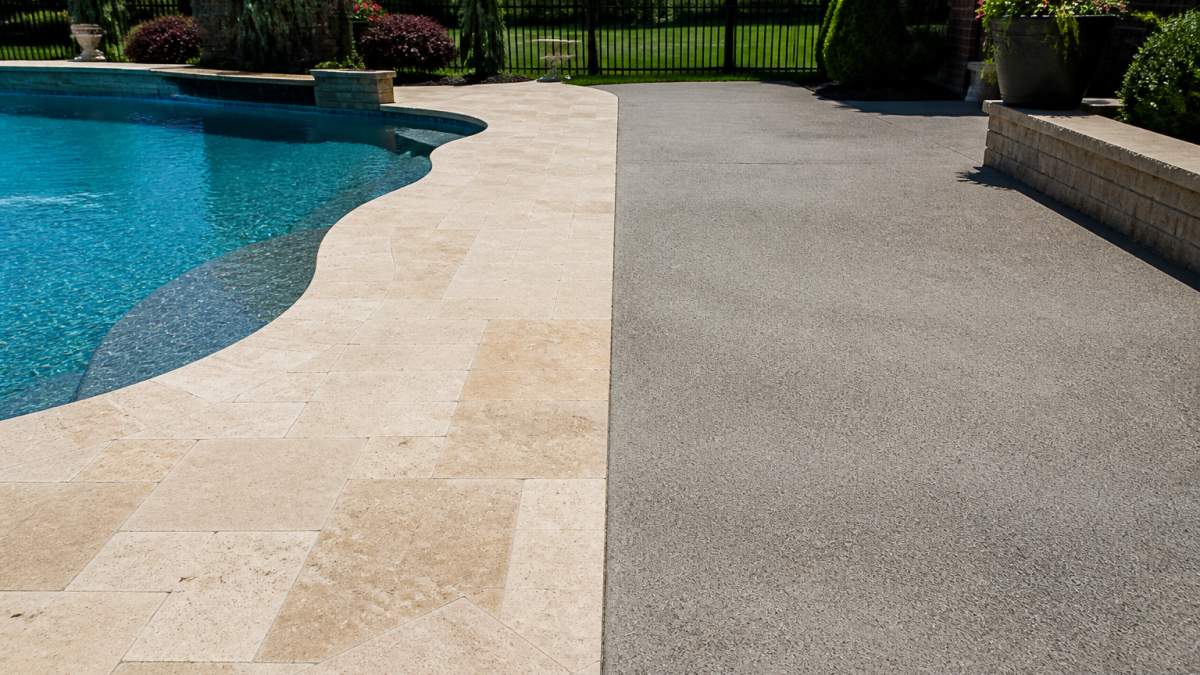
| Travertine pavers | $18-$25 | 30+ years | Hot climates, barefoot comfort |
| Bluestone | $30-$55 | 50+ years | Luxury builds, freeze-thaw areas |
Lifespan and Long-Term Cost
Concrete’s lower sticker price hides a shorter service life. Ground movement and clay soil cause hairline cracks that widen over time, and most concrete decks need patching or resurfacing well before a stone deck needs anything at all. Travertine and bluestone pavers can be lifted and reset individually, so a single cracked piece never means replacing the whole deck.
Run the math over 30 years and the gap narrows considerably. That is the part most cost guides skip.
What Drives Pool Decking Cost Per Square Foot
Four variables move pool decking cost more than anything else: material, labor, deck size, and site conditions. Understanding them helps you read any estimate critically instead of comparing bottom-line numbers that were never calculated the same way.
Material and Installation Cost Factors
Material price is only part of the equation. Stone arrives on pallets, gets sorted by hand, and often needs a thicker base to sit level. Concrete arrives as a truckload and cures in place.
- Material: Stone costs several times more per square foot than a concrete mix.
- Labor: Setting individual pavers takes longer than pouring and finishing a slab.
- Base prep: Expansive clay soil may require additional base depth and drainage work.
- Access: A narrow side yard means hand-carrying material, which adds hours.
- Finishes: Thermal, natural cleft, and brushed finishes each carry different labor.
Deck Size and Project Assumptions
A 600-square-foot deck is the standard reference point in most cost guides, and it is a useful one. It comfortably surrounds a typical pool with room for loungers and a walkway.
Ask any contractor what their per-square-foot figure assumes. Does it include demolition of an old deck? Drainage? Coping? A quote that excludes those items is not cheaper, it is just incomplete.
The most common estimate mistake is comparing a bare concrete price against a stone price that includes base prep and drainage. Always ask what is excluded before you compare two numbers.
Concrete Pool Decking: Styles, Finishes, and Costs
Concrete is the practical default for most residential pools, and for good reason. It installs fast, costs the least, and can be finished in ways that look far more expensive than they are.
Broom-finished concrete is the workhorse. Crews drag a stiff broom across the wet surface to leave fine parallel grooves that provide grip underfoot. It is the least expensive option at $5-$8 per square foot installed, and color additives can warm up the flat gray.
Stamped concrete presses patterned mats into the surface to mimic stone, brick, or wood. At $12-$18 per square foot, it delivers a high-end look for less than half the cost of real stone. The catch: it needs periodic resealing to hold its appearance, and it can turn slick when wet if the finish is not properly textured.
Where concrete falls short is repair. A crack runs until it is patched, and patches rarely blend invisibly. In clay soil areas, that matters more than it does elsewhere.
Natural Stone Pool Decking: Travertine, Bluestone, Limestone, and Flagstone
Natural stone costs more because it does more. Each type behaves differently underfoot and under weather, so the choice matters as much as the price.
Travertine is a natural limestone formed by mineral springs. It stays noticeably cooler than concrete in direct sun, which is why it dominates pool decks in hot climates. It is porous and slip-resistant, and individual pavers can be swapped out if one cracks. Expect $18-$25 per square foot installed.
Bluestone is a dense sandstone with a blue-gray palette available in thermal or natural cleft finishes. It resists freeze-thaw cycles well and holds up for decades, but at $30-$55 per square foot it is the highest-cost category.
Limestone and flagstone round out the options. Limestone offers a softer, more uniform look; flagstone brings irregular shapes and dramatic color variation. Both need a properly compacted base, since uneven settling shows up quickly in irregular stone.
Travertine’s cool-to-the-touch quality is not marketing. Its porous structure holds less surface heat than dense concrete, which is why it is the go-to choice for decks that get full afternoon sun.
Travertine vs Concrete Pool Deck Pros and Cons
Travertine vs concrete pool deck pros and cons usually reduce to three questions: how hot does the surface get, how slippery is it wet, and how much upkeep does it need?
| Factor | Travertine Pavers | Concrete |
|---|---|---|
| Upfront cost | $18-$25/sq ft | $5-$18/sq ft |
| Surface heat | Stays cooler | Retains heat |
| Slip resistance | Naturally textured | Depends on finish |
| Repairs | Swap single pavers | Patch or resurface |
| Maintenance | Reseal every 1-2 years | Seal as needed |
| Cracking risk | Low | Higher in clay soil |
For homeowners who plan to stay put, travertine’s longevity and comfort often justify the premium. For a rental property or a short-term hold, concrete is the rational call.
Pool Deck Resurfacing Cost: When to Repair Instead of Replace
Pool deck resurfacing cost is almost always lower than full replacement, and it is the right move when the underlying structure is still sound. If the deck has surface wear, faded color, or minor cracking but sits level and drains properly, a resurfacing overlay can add years of service at a fraction of replacement.
Replacement makes more sense when the deck has settled unevenly, when cracks run deep into the slab, or when you are already changing the pool’s shape. Resurfacing a deck that is structurally failing just delays the inevitable.
The honest test is drainage. If water pools against the deck edge or runs toward the house, the problem is underneath, and a new surface will not fix it.
Slip Resistance, Heat, and Maintenance: Performance Beyond Price
Price gets the attention, but performance decides whether you actually enjoy the deck. Three factors matter most.
Slip resistance comes from texture. Broom finish, thermal-finished stone, and natural cleft surfaces all provide grip. Polished or over-sealed surfaces do not, and they get dangerous when wet.
Heat retention separates the materials sharply. Dense concrete absorbs and radiates heat; porous travertine stays cooler underfoot. In full sun, that difference decides whether the deck is usable at 3 p.m.
Maintenance follows a predictable rhythm. Concrete needs sealing as it ages and patching when it cracks. Stone needs resealing every 1-2 years to protect the surface, plus occasional re-leveling of individual pavers.
Choose your deck for how it performs at 3 p.m. in July, not for how it looks in a brochure. Heat and grip determine whether you use the space.
Conclusion
Every pool deck eventually forces a decision: save now on concrete, or pay more upfront for stone that lasts decades and stays comfortable underfoot. The right answer depends on your soil, your sun exposure, and how long you plan to call the house home.
At Swim Clean Pool, we design and build custom pools and outdoor living spaces across North Texas, and we manage every project personally from first consultation to final walkthrough. Our Owner personally project manages each project and expertise in remodels and equipment replacement mean you receive professional guidance and a tailor-made retreat where lasting family memories are made. We know how expansive clay soil behaves under a deck, and we plan for it before the first shovel hits the ground.
Request a consultation with Swim Clean Pool and get a deck plan built around your property, your budget, and how you actually use your backyard.
Frequently Asked Questions
What is the least expensive pool deck material?
Broom-finished concrete is the least expensive option, typically starting around $5 to $8 per square foot installed. It offers slip resistance and durability at the lowest upfront cost. Stamped concrete runs $12 to $18 per square foot, while natural stone like travertine starts at $18 to $25 per square foot. If budget is your top priority, plain concrete delivers functional performance without the premium price of stone.
How much does a concrete pool deck cost per square foot?
Standard broom-finished concrete costs roughly $5 to $8 per square foot installed. Decorative stamped concrete runs $12 to $18 per square foot. These figures include material and labor for typical residential projects. Your actual pool decking cost depends on deck size, site access, soil conditions, and regional labor rates. A 600-square-foot deck at $6 per square foot would run about $3,600 before any add-ons like color additives or custom borders.
What are the long-term maintenance costs of natural stone vs concrete?
Concrete decks typically need resealing every one to two years to prevent cracking and fading, which adds ongoing expense. Natural stone like travertine and bluestone generally requires less frequent sealing, often every two to three years, and individual pavers can be replaced if damaged. However, natural stone has a higher upfront cost. Over a 15-year period, the gap narrows when you factor in concrete repairs and repeated sealing versus stone’s durability and easier spot repairs.
Does natural stone pool decking increase home value more than concrete?
Natural stone decking can boost perceived home value because buyers associate travertine and bluestone with luxury outdoor living. In high-end markets, a stone deck may help a home stand out. Concrete, especially stamped concrete, offers a similar look at a lower price but does not carry the same premium association. The actual return depends on your local market, home price tier, and how well the deck integrates with the overall backyard design.
How does installation time differ between concrete and stone pavers?
Concrete decks typically cure in three to seven days before you can use them, with installation taking two to four days for a standard deck. Stone paver installation takes longer, often five to ten days, because each paver is set individually on a sand or mortar bed. Travertine and bluestone require precise leveling to prevent uneven surfaces. The trade-off is that stone pavers allow easier future repairs since you can lift and replace individual pieces.