
Table of Contents
- What to Look for in Pool Builders in Dallas
- Average Cost of an Inground Pool in Dallas
- Pool Construction Timeline: What to Expect
- Custom Pool Design Trends for 2026
- Pool Financing Options for Dallas Homeowners
- How to Vet and Compare Pool Builders in Dallas
- Frequently Asked Questions
Last Updated: September 10, 2026
What to Look for in Pool Builders in Dallas
Choosing among pool builders in Dallas starts with three checks: a valid contractor license, current liability and workers’ compensation insurance, and a written warranty that spells out what’s covered and for how long. Skip any one of these and you’re carrying the risk on a project that costs more than most cars.
Here’s what to verify before you sign anything.
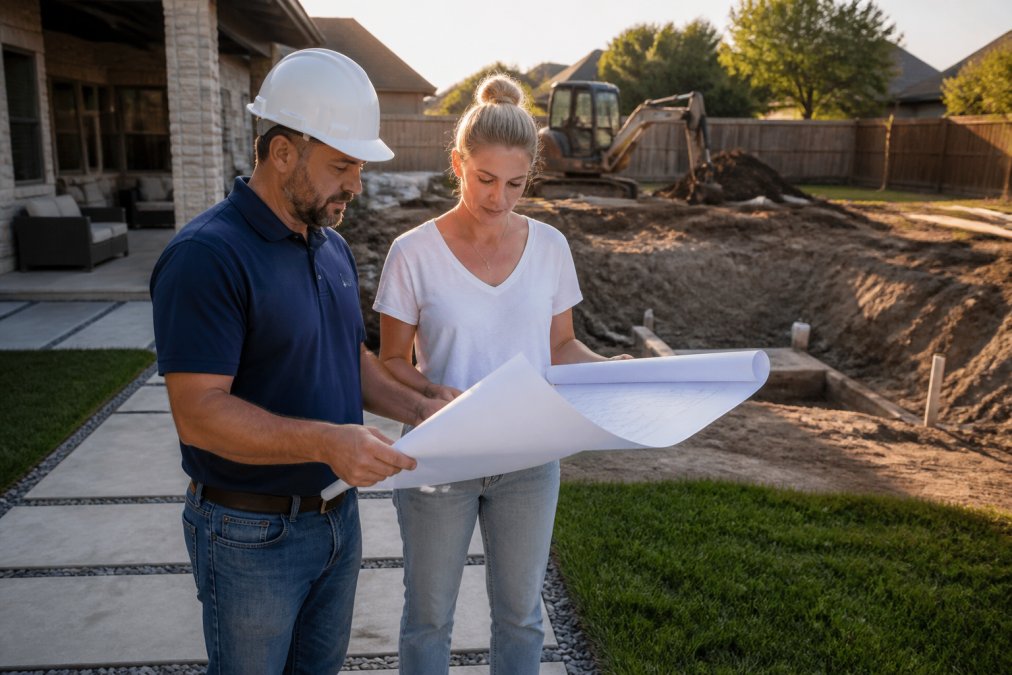
Licensing, Insurance, and Warranty Coverage
A licensed contractor carries a state or municipal credential you can verify, and that credential means someone else has confirmed basic competence (texas.gov). Ask for the license number, then check it against the issuing authority’s public database. Insurance matters just as much: liability coverage protects your property, and workers’ compensation protects you from being sued if a crew member gets hurt on your land.
Warranty coverage is where builders quietly compete. Some offer a structural warranty measured in years, others in decades. Get the terms in writing, and ask specifically what voids it. A common mistake is assuming “lifetime” means the pool, when it often means only the shell.
Design-Build vs. Subcontracting: Why It Matters
Design-build means one company handles design, engineering, and construction under a single contract. Subcontracting splits those responsibilities across separate firms, and that’s where finger-pointing begins. When the deck cracks and the plumber blames the excavator, you’re the one stuck in the middle.
For most homeowners, design-build is the better structure. One point of accountability, one schedule, one warranty. The trade-off is that you’re committing to a single firm’s design vision rather than shopping each phase separately.
Average Cost of an Inground Pool in Dallas
Pricing for an inground pool depends on size, materials, site conditions, and the features you add, so any builder quoting a number before seeing your yard is guessing. That said, refusing to give any range at all isn’t helpful either. Here’s how the market generally breaks down so you can sanity-check proposals.
Pricing for inground pools in this market can vary significantly. Simple rectangular pools with basic finishes are at the lower end, while custom shapes with spas, water features, and integrated outdoor living spaces can be considerably more. The type of pool (concrete, vinyl-liner, or fiberglass) also influences the initial cost, with differences narrowing once comparable decking, equipment, and features are added.
A useful way to think about it is by tier:
| Tier | Typical Scope | What Pushes It Up |
|---|---|---|
| Entry | Rectangular gunite, standard plaster, basic pump and filter, small deck | Depth, deck square footage, site access |
| Mid | Freeform shape, upgraded finish, spa, LED lighting, automation | Water features, hardscaping, equipment brand |
| Custom | Infinity edge, integrated outdoor kitchen, fire features, full automation | Grade work, structural engineering, imported tile |
Swim Clean Pool builds 100% custom designs, which means the number is derived from your property, not pulled from a menu. Request a consultation for a project-specific quote rather than relying on a ballpark. But use the tiers above to pressure-test any bid you receive, if a proposal comes in far below the entry range for a scope that looks mid-tier, something is missing from the line items.
What Drives the Price Up or Down
- Size and depth: more excavation, more steel, more concrete, more finish
- Shape complexity: freeform curves cost more labor than straight lines
- Features: spas, infinity edges, water features, and automation systems each add cost
- Deck and hardscaping: the pool deck often rivals the pool itself in spend
- Site access: tight lots and mature trees slow equipment and raise labor hours
- Soil conditions: expansive clay may require piers or engineered reinforcement, which adds structural cost before a single finish is chosen
- Permits and inspections: fees vary by jurisdiction and add both hard cost and schedule time
How to Compare Bids Without Getting Burned
Two proposals with the same bottom line are rarely the same project. Ask each builder to itemize excavation, steel, plumbing, gunite, finish, coping, tile, decking, equipment, permits, and cleanup as separate lines. Then compare line by line, not total to total. A bid that omits drainage, decking, or equipment upgrades isn’t cheaper, it’s incomplete, and the missing items reappear as change orders once excavation has already started and you have no leverage.
Pool Construction Timeline: What to Expect
A typical inground pool takes several months from contract to swim-ready, though the exact schedule depends on permitting, weather, and inspection windows. Most of that time isn’t construction at all. It’s waiting on approvals.
The build itself moves in a predictable sequence: layout and excavation, steel and plumbing, gunite application, curing, then finishes like plaster, coping, and tile work. Expect the gunite stage to look alarming. It’s a rough, gray shell, and it stays that way for weeks while it cures.
U.S. Consumer Product Safety Commission pool safety guidance
Permitting and Zoning Requirements in Dallas
Most guides skip permitting entirely, and that’s a mistake. Pool construction typically requires building permits, electrical permits, and sometimes plumbing permits, plus compliance with local setback and barrier rules. Barrier requirements exist to prevent drownings, and inspectors take them seriously (cpsc.gov).
Ask any builder you interview who pulls the permits. If the answer is “you do,” walk away. A legitimate contractor pulls permits in their own name because the inspection record follows them.
Soil and Foundation Considerations for North Texas
Expansive clay soil is the defining engineering challenge for pools in this region. Clay swells when wet and shrinks when dry, and that movement pushes against a pool shell with real force. Structural integrity depends on engineering for that movement, not hoping it won’t happen.
A site survey and soil assessment should come before design, not after. Piers, reinforced shells, and proper drainage all exist to manage soil movement. Skipping that step is how pools develop cracks in year three.
Custom Pool Design Trends for 2026
Custom pool design in 2026 leans toward spaces that work year-round rather than just in July. Homeowners are asking for integrated outdoor living: covered seating, outdoor kitchens, fire features, and lighting that extends usable hours into the evening.
The luxury pool conversation has shifted from “how big” to “how well does it fit the yard.” Infinity edges still draw attention, but they only work on the right lot with the right grade. Water features and spa installations are being designed as part of the hardscaping rather than bolted on afterward.
Sustainable and Eco-Friendly Upgrades
Energy-efficient equipment is the upgrade that pays back every month. Variable-speed pumps, LED lighting, and automation systems that schedule runtime around actual use all reduce consumption compared with older single-speed setups. Automation also catches problems early. A pump running outside its normal pressure range usually means a clog or a failing component, and you’ll know before it becomes a repair.
Pool Financing Options for Dallas Homeowners
Pool financing options generally fall into a few categories: home equity loans or lines of credit, dedicated pool loans from specialty lenders, and contractor-arranged payment plans. Home equity products often carry the lowest rates because the loan is secured against your property, but they also put your home on the line. Unsecured pool loans carry higher rates but don’t tie your house to the debt. Contractor-arranged plans are convenient but usually route through a third-party lender, so read the terms as carefully as you would a bank’s.
Ask every lender two questions: what’s the total cost over the life of the loan, and are there prepayment penalties. A lower monthly payment stretched over more years can cost far more than a shorter term at a slightly higher rate. Run the total-cost math on at least two offers side by side before you commit.
Total Cost of Ownership: What You’ll Pay After Construction
This is the gap topic almost nobody covers. The build price is the entry fee, not the total spend. Ongoing costs include electricity for pumps and heating, chemicals, regular maintenance, equipment replacement on a multi-year cycle, and occasional resurfacing or replastering. Over a decade of ownership, these recurring costs can add up to a meaningful fraction of the original build price, which is why planning for them matters more than shaving a few thousand dollars off the bid.
| Ongoing Cost Category | What Drives It | Planning Approach |
|---|---|---|
| Electricity | Pump type, runtime, heating | Variable-speed equipment, scheduled runtime |
| Chemicals | Pool volume, usage, sunlight | Test regularly, dose accurately |
| Maintenance | DIY vs. professional service | Decide before construction ends |
| Equipment replacement | Age and duty cycle | Set aside a monthly reserve |
| Resurfacing | Finish type and water chemistry | Expect it on a long cycle |
| Water and sewer | Fill volume, evaporation, backwashing | Cover when not in use to cut evaporation |
Budget for the pool the way you’d budget for a car: purchase price plus a maintenance reserve. Homeowners who plan for the reserve are rarely surprised. Homeowners who don’t are the ones calling around after a pump fails in August.
The cheapest bid and the cheapest pool are different things. A lower build price financed over a longer term, paired with higher ongoing energy and chemical costs, can cost more over ten years than a slightly higher build price with efficient equipment and a shorter loan.
How to Vet and Compare Pool Builders in Dallas
Comparing builders comes down to documentation, not salesmanship. Ask each finalist for the same packet and score them against identical criteria. The builder who hesitates on paperwork is telling you something.
Use this checklist for every builder you interview:
- License number provided and verified with the issuing authority
- Certificate of insurance for liability and workers’ compensation
- Written warranty terms, including what voids coverage
- Confirmation that the builder pulls all permits in their own name
- Site survey and soil assessment included before design
- Itemized proposal showing what’s included and what’s excluded
- Named project manager and a written communication schedule
- Change-order process documented in writing
- References from projects completed at least two years ago
That last item matters more than the rest. A builder’s recent references show you a project in its honeymoon phase. References from two or more years back show you how the pool and the relationship held up.
The most expensive mistake in pool construction is choosing the lowest bid without comparing scope. A proposal that omits decking, drainage, or equipment upgrades isn’t cheaper, it’s incomplete. The missing line items reappear as change orders once excavation has already started and you have no use.
Kathy K., a Swim Clean Pool customer, put it plainly: “Carson goes above and beyond in his work and it shows. He is very professional and knowledgeable on all types of pool equipment. I trust service techs like Carson with the experience needed for the job and to get it done right the first time.”
That’s the standard to hold every builder to. Not the pitch, the follow-through.
A pool project asks you to commit serious money to a contractor you barely know, and the difference between a smooth build and a two-year headache comes down to who’s accountable when something goes wrong. Swim Clean Pool handles design, construction, and project management under one roof, with the owner personally managing each project from consultation through completion. Our team specializes in 100% custom-designed pools, spas, and outdoor living areas, plus remodels and equipment replacement for existing pools. Get started with Swim Clean Pool and build a backyard retreat designed around your property, not a template.
Frequently Asked Questions
What is the average cost to build a pool in Dallas?
The average cost of an inground pool in Dallas varies based on size, materials, and features. A basic gunite pool with standard finishes represents an entry-level investment, while custom designs with spas, water features, and outdoor living areas can be significantly higher. Soil conditions, permitting fees, and decking choices also affect the final price. Request a detailed quote from pool builders Dallas homeowners trust to get accurate numbers for your specific project.
How long does the pool construction timeline take in North Texas?
Most pool construction timelines in North Texas run 8 to 12 weeks from excavation to completion, though complex designs or permitting delays can extend that to 16 weeks. The process includes design approval, permitting, excavation, gunite application, plumbing, electrical work, decking, and final inspection. Weather and material availability also affect scheduling. Ask your builder for a phase-by-phase timeline upfront so you know what to expect.
What should I look for when vetting pool builders in Dallas?
Check for a valid contractor license, liability insurance, and workers’ compensation coverage. Ask for at least three local references and photos of completed projects similar to yours. Confirm whether the builder handles permitting and inspections or expects you to coordinate. Get a written contract with a detailed scope, payment schedule, and warranty terms. A design-build firm that manages the entire project reduces the risk of finger-pointing between subcontractors.
What are the pool financing options for Dallas homeowners?
Pool financing options include home equity loans, home equity lines of credit (HELOCs), personal loans, and specialty pool financing through lenders. Home equity loans often offer lower interest rates because they are secured by your property. Some builders partner with lenders to offer streamlined approval. Compare terms carefully and ask about prepayment penalties. A reputable builder will provide a written estimate you can share with lenders before you apply.

