
Table of Contents
- Saltwater Pool Maintenance Schedule for Dallas Homeowners
- Pool Water Chemistry Balance in North Texas
- Salt Cell Cleaning Frequency and Maintenance
- Managing High Water Hardness and TDS in Dallas
- Protecting Saltwater Pool Equipment During Freezes
- DIY vs. Professional Saltwater Pool Maintenance in Dallas
- When to Call a Pool Professional
- Frequently Asked Questions
Last Updated: September 11, 2026
Saltwater Pool Maintenance Schedule for Dallas Homeowners
Learning how to maintain a saltwater pool in Dallas starts with one hard truth: the “saltwater” label is a chemistry setup, not a self-cleaning system. A salt chlorinator splits dissolved salt into sanitizer through electrolysis, but it does nothing about pH drift, rising calcium, or the mineral load that North Texas water and triple-digit heat dump into your pool. This guide from Swim Clean Pool covers the schedule, chemistry, and equipment care that keep a salt system running through a Dallas summer and a February freeze.
Saltwater pool maintenance is the ongoing practice of balancing water chemistry, cleaning the salt cell, and managing mineral concentration in a pool sanitized by a salt chlorination system rather than direct chlorine dosing. The core difference from a traditional pool is where the chlorine comes from, not whether you still test and balance.
| Task | Frequency | Time Required |
|---|---|---|
| Test pH, alkalinity, sanitizer | 2-3x per week | 10 minutes |
| Skim surface and empty baskets | Weekly | 15 minutes |
| Brush walls and steps | Weekly | 20 minutes |
| Clean cartridge filter | Every 4-6 weeks | 30 minutes |
| Inspect and clean salt cell | Every 8-12 weeks | 30 minutes |
| Full water test at a lab | Monthly | Drop-off |
Weekly Tasks
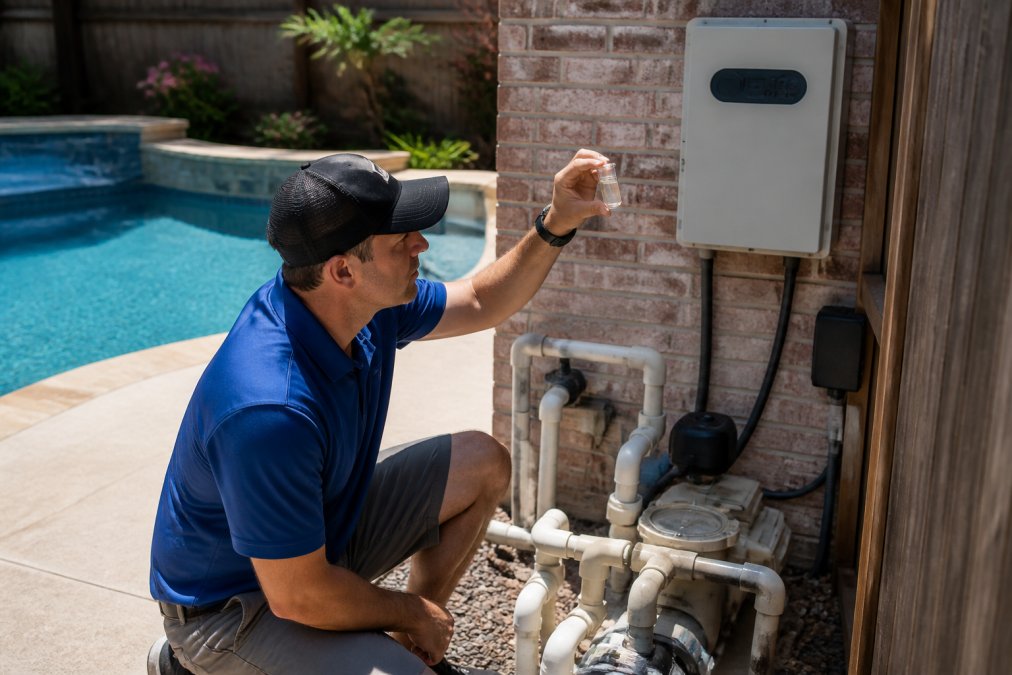
Test pH and total alkalinity two to three times a week during swim season. Dallas heat and heavy bather load push pH up fast, and a salt cell raises it further as an electrolysis byproduct. Skim the surface, empty the skimmer and pump baskets, brush the walls and steps, and run the pump long enough to turn over the full water volume daily.
Monthly and Seasonal Tasks
Rinse the cartridge filter every four to six weeks, or sooner after a dust storm or heavy pollen. Test calcium hardness and cyanuric acid monthly, since both climb steadily here. Before winter, lower the water level to the recommended mark, protect the equipment pad, and cut run time as water temperature drops.
Pool Water Chemistry Balance in North Texas
Water chemistry balance is the biggest difference between a salt pool that runs itself and one that turns green or scales the cell. Salt systems are unforgiving about pH: when pH drifts high, the cell works harder and produces less sanitizer. Keep pH in the low-to-mid 7s, total alkalinity at 80-120 ppm, and calcium hardness within your surface manufacturer’s range (the CDC).
The local twist is the fill water. Municipal supplies draw from hard limestone and Trinity aquifer sources, so source water commonly tests high in calcium and total alkalinity before it reaches your pool. Every top-off adds that mineral load, and because evaporation leaves minerals behind, calcium hardness and TDS climb all season. That combination, high pH, high calcium, warm water, drives scale onto salt cell plates and the tile line.
Reading the Saturation Index, Not Just Single Numbers
Balanced-looking numbers can still scale or corrode. The Langelier Saturation Index (LSI) captures the relationship between pH, calcium hardness, total alkalinity, water temperature, and TDS. A slightly negative index (roughly -0.3 to 0) is generally safe; a persistently positive index means the water is depositing calcium. In a hot climate with hard fill water, the index drifts positive fast, so a cell clean in spring can be scaled by midsummer even when pH reads “normal.”
Testing pH, Alkalinity, and Calcium Hardness
Use a liquid test kit with fresh reagents rather than strips for the numbers that matter. Strips are fine for a quick sanitizer check but too imprecise for pH and alkalinity adjustments. Test in this order:
- Total alkalinity first, since it buffers pH
- pH second
- Calcium hardness and cyanuric acid monthly
- Salt level with a digital meter or the cell’s own readout
Test at the same time of day each session. Late afternoon readings after a full day of sun and swimmers show you the worst-case chemistry, which is the number that actually matters.
Why Salt Pools Drift Differently
The chlorinator itself is a pH-raising machine. Electrolysis produces sodium hydroxide as a byproduct, so a salt pool climbs in pH faster than a manually chlorinated pool. Expect to add acid more often and to adjust alkalinity downward periodically, not only upward. Cyanuric acid also matters: it shields chlorine from sunlight, but too much of it locks the sanitizer and forces you to dilute.
When Chemistry Will Not Hold
If pH rebounds within a day, calcium hardness keeps climbing after a partial drain, or the cell reports low output despite clean plates, the problem is usually source water, a failing reagent, or an equipment fault, not a missing chemical. Test your fill water once to know your baseline, and recheck it if your supplier changes sources seasonally.
Salt Cell Cleaning Frequency and Maintenance
Clean your salt cell every eight to twelve weeks during swim season, and inspect it monthly for visible scaling. The cell is the most expensive wearable part of a salt system, and calcium scale kills it early. When scale coats the plates, the cell loses efficiency, the control box reports low output, and you run it longer to compensate, accelerating the wear.
A common mistake is reaching for muriatic acid on every cleaning. Acid removes scale but also strips a thin layer of the rare-metal coating on the plates each time. For light, soft buildup, a strong blast from a garden hose is enough. Save the acid bath for hard, visible scale, and follow the manufacturer’s dilution ratio exactly.
Never clean the cell while it is still connected to the control box or while the pump is running. Residual current and pressurized water lines can cause injury, and the cell’s plastic housing cracks easily if handled wet and hot.
Managing High Water Hardness and TDS in Dallas
High calcium hardness and rising total dissolved solids are the defining challenge of saltwater pool care in North Texas. Local water runs hard, and every top-off adds more calcium and minerals. Evaporation concentrates them because the minerals stay behind. Over a season, TDS climbs, scale forms on the cell and tile line, and the water stops holding a balance.
The fix is dilution, not another chemical. When calcium hardness or TDS climbs past the working range, partially drain and refill with fresh water, the only reliable way to lower dissolved solids. Test your fill water first, and never drain below the manufacturer’s safe level without checking with a professional, since a fully drained pool in expansive clay soil can shift or crack.
Protecting Saltwater Pool Equipment During Freezes
Freeze protection is the task pool owners skip until the first hard freeze, and the one that costs the most when ignored. A sustained freeze can crack pumps, filters, heaters, and exposed plumbing in a single night. Salt systems add one more risk: the control box and flow sensor are electronics that fail in cold, wet conditions.
The mechanism is simple physics. Water expands as it freezes, and any water trapped in a pump housing, filter tank, heater manifold, or exposed PVC line can split the component from the inside. Equipment-pad plumbing is most exposed, but buried lines can crack if flow stops and the ground freezes around them.
How Freeze Protection Actually Works
Most modern variable-speed pumps and automation controllers include a freeze-protection mode that starts the pump when air temperature hits a set threshold, typically around 35°F, then runs it continuously because moving water resists freezing (energy.gov). Two things commonly defeat this feature:
- The setting is disabled or set too low after a previous owner turned it off.
- The pump loses power, so the automation cannot start it.
Confirm the freeze-protection threshold and that the pump is set to run, not just idle, when triggered. If your system has no automation, you will need to run the pump manually through the freeze.
Salt-System-Specific Cold-Weather Risks
- Salt cell output in cold water. Most chlorinators reduce or stop chlorine production below roughly 50-60°F, so do not expect the cell to sanitize through a freeze (peer-reviewed research). Keep a manual chlorine source on hand.
- Flow sensor and control box. These are the electronics most likely to fail in cold, wet conditions. Make sure the sensor is seated, dry, and not cracked before the first freeze.
- Cell housing. A drained or partially drained cell can trap water and crack. Leave the system assembled and circulating rather than pulling the cell for the winter.
- Salt level. Cold water holds less dissolved salt, and a low salt reading can trigger a false low-salt fault. Verify salt with a digital meter rather than trusting the cell readout in cold water.
Before the First Freeze Warning
- Confirm the freeze-protection setting on the pump and control box is enabled
- Check that the pump runs continuously when air temperature drops near freezing
- Insulate exposed pipes and the equipment pad
- Verify the salt cell and flow sensor are seated and dry
- Know where your breaker and drain plugs are before you need them
- Keep a manual chlorine source and a spare test kit on hand
If You Lose Power During a Freeze
This scenario causes the most damage, because the pump cannot circulate and the risk jumps immediately. If you expect a prolonged outage, drain the pump, filter, heater, and exposed plumbing at the equipment pad, the same winterization step used in colder regions, rather than gamble on power returning. Keep your drain plugs and the tools to remove them accessible. Do not drain the pool shell itself; a fully drained pool in expansive clay soil can shift or crack.
Never leave a pool running unattended through a hard freeze without confirming freeze protection is active. A single night of stopped circulation is enough to crack a pump housing or heater manifold.
After the Thaw
Once temperatures rise above freezing, inspect the equipment pad for cracked fittings, check the pump for unusual noise or leaks, and re-test chemistry, a freeze often disturbs pH and sanitizer levels. If the pump tripped a breaker or the cell reports a fault, treat it as an equipment issue and have it diagnosed before restarting under load.
DIY vs. Professional Saltwater Pool Maintenance in Dallas
Doing the weekly work yourself is realistic for most homeowners and saves money. The tasks that genuinely require a professional are the ones with real consequences: lowering water level safely, diagnosing a failing cell or flow sensor, repairing equipment, and correcting badly drifted chemistry. Routine testing and cleaning are well within reach for a careful owner.
| Task | DIY Feasible | Why |
|---|---|---|
| Weekly testing and balancing | Yes | Simple with a good kit |
| Skimming and brushing | Yes | No special tools needed |
| Filter cleaning | Yes | Straightforward maintenance |
| Diluting high TDS water | No | Risk to surface and structure |
| Cell or sensor replacement | No | Diagnosis and warranty concerns |
| Equipment repair | No | Requires parts and expertise |
When to Call a Pool Professional
Call a professional when the numbers will not hold, equipment fails, or a repair risks your warranty. Persistent algae despite balanced chemistry, a cell reading low output after cleaning, a pump that trips its breaker, or water that will not clear all signal a mechanical or structural problem, not a chemical one. More chemicals just mask the issue.
This is where Swim Clean Pool fits. Our team handles equipment replacement, diagnostics, and remodeling work. As Kathy K. put it, “Carson goes above and beyond in his work and it shows. He is very professional and knowledgeable on all types of pool equipment.” If you are not sure whether a problem is a chemistry issue or an equipment failure, that is exactly the call worth making.
Maintaining a saltwater pool in Dallas is a schedule, not a single task, and the climate makes consistency non-negotiable. If your chemistry will not stabilize, your equipment is aging, or you want a system designed and serviced for North Texas water and weather, Swim Clean Pool can help. We offer a full-service design-build process, 100% custom pool and outdoor living design, expert equipment replacement, and hands-on project management from consultation through completion. Request a consultation with Swim Clean Pool and get a pool that performs the way it should.
Frequently Asked Questions
How often should I test the salt levels in my pool?
Test salt levels every two weeks during peak season and monthly in cooler months. Dallas heat causes evaporation that concentrates salt, so you may need to add water and recheck. Use a digital salt meter or test strips for accuracy. The ideal range is 2,700 to 3,400 ppm for most salt chlorine generators. If levels drop below 2,500 ppm, the cell may not produce chlorine efficiently, leading to cloudy water or algae growth.
What is the ideal pH range for a saltwater pool?
Keep pH between 7.4 and 7.6 for a saltwater pool. Salt systems tend to raise pH over time, so test weekly and adjust with muriatic acid or pH decreaser. High pH reduces chlorine effectiveness and speeds up scaling on the salt cell. Dallas water is often hard, which can push pH higher. If pH climbs above 7.8, add acid in small doses and retest after a few hours.
Do saltwater pools require less maintenance than chlorine pools?
Saltwater pools still need regular maintenance, but you avoid buying, storing, and handling chlorine tablets. You must clean the salt cell every three months, test water chemistry weekly, and manage pH more closely. In Dallas, hard water and high heat mean more frequent cell cleaning and water dilution. The trade-off is softer water and no harsh chlorine smell, but the time spent on upkeep is similar to a traditional pool.
How do I prevent salt cell scaling in high-heat climates?
Prevent scaling by keeping pH below 7.8, calcium hardness between 200 and 400 ppm, and total alkalinity at 80 to 120 ppm. In Dallas, hard water and evaporation concentrate minerals, so dilute the pool with fresh water when TDS exceeds 1,500 ppm. Inspect the salt cell every three months and clean it with a diluted muriatic acid solution if you see white flakes. A scale inhibitor can also help.

