
Table of Contents
- How Energy Efficient Pool Pumps Cut Operating Costs
- Department of Energy Pool Pump Regulations and What They Mean for You
- How to Choose the Right Pool Pump Size for Your Pool
- Quieter Operation and Other Everyday Benefits of Energy Efficient Pool Pumps
- Pros and Cons of Energy Efficient Pool Pumps
- When to Upgrade and How to Plan the Installation
- Frequently Asked Questions
Last Updated: September 11, 2026
How Energy Efficient Pool Pumps Cut Operating Costs
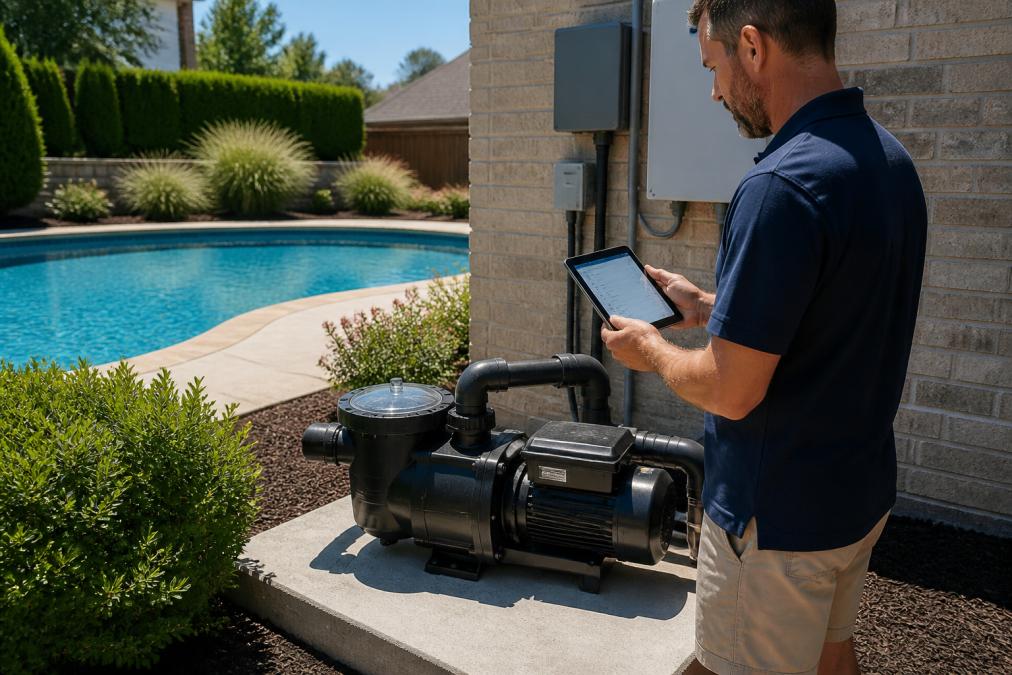
The benefits of installing energy efficient pool pumps start with the electric bill. A variable speed pool pump is a motor that lets you dial filtration speed up or down instead of forcing it to run full-tilt every hour it operates. Because pump energy demand climbs steeply with speed, slowing the motor for routine circulation cuts consumption dramatically (energy.gov).
A common approach is to run high speed only for skimming, vacuuming, or spa use, then drop to low speed for the rest of the day. Many pool owners find their pump becomes one of the smallest line items on the utility bill instead of one of the largest.
What the Savings Look Like Over a Season
Savings scale with how many hours your pump runs and how much of that time you spend at reduced speed. A single-speed pump draws its full rated wattage the entire time it runs. A variable speed unit might spend most of the day at a fraction of that draw.
Over a full swim season, the difference compounds. The U.S. Department of Energy guidance on pool pump energy use notes that pool pumps can consume substantial household electricity, which is why efficiency improvements matter so much in warm climates with long swim seasons.
Beyond Electricity: Rebates and Longer Equipment Life
Lower speed means less mechanical stress. Motors run cooler, seals wear more slowly, and the pump runs quieter. Many utilities also offer rebates for qualifying high-efficiency pumps, so it is worth checking with your local provider before you buy.
Run your pump during off-peak hours whenever your utility offers time-of-use rates. Pairing a variable speed pump with an overnight schedule is one of the simplest ways to stack savings without touching water chemistry.
Department of Energy Pool Pump Regulations and What They Mean for You
Federal rules now require most new pool pumps sold in the United States to meet minimum energy-efficiency standards. The U.S. Department of Energy appliance and equipment standards sets these thresholds, which effectively ended the sale of many traditional single-speed pumps for typical residential use.
For homeowners, this is good news. It means you can no longer accidentally buy the least efficient option on the shelf. It also means replacement parts and service for older single-speed pumps will gradually become harder to source. If your current pump is aging, planning ahead beats being forced into a rushed decision mid-season.
How to Choose the Right Pool Pump Size for Your Pool
Sizing a pool pump is a math problem before it is a shopping decision. The goal is to move your pool’s full volume through the filter in a reasonable turnover window, commonly 8 to 10 hours for a residential pool, without pushing flow past what your plumbing and filter can handle. Oversizing wastes energy and can damage filtration components. Undersizing leaves you with cloudy water and constant clarity problems.
Here is the calculation most installers actually run:
- Find your pool volume in gallons. Length × width × average depth × 7.5 for a rectangular pool. A 16 × 32 ft pool with an average depth of 5 ft holds roughly 19,200 gallons.
- Pick a turnover target. Divide gallons by your target hours. 19,200 ÷ 8 = 2,400 gallons per hour, or 40 gallons per minute.
- Check your plumbing. A 1.5-inch return line typically handles about 40-50 GPM comfortably; 2-inch lines handle more. If your target flow exceeds what the pipe can move, you will get high pressure, noise, and cavitation rather than better filtration.
- Check your filter’s rated flow. A sand or cartridge filter has a maximum flow rate printed on the tank. Exceeding it forces debris through the media instead of trapping it.
- Add head loss. Every 90-degree fitting, check valve, heater, and solar panel adds resistance. A pump rated for 60 GPM at zero head might deliver 40 GPM in a real system with a heater and a spa loop.
| Pool Consideration | What It Affects | What to Do |
|---|---|---|
| Water volume | Turnover time needed | Size flow rate to your gallons |
| Plumbing size | Maximum usable flow | Match pump to pipe diameter |
| Features (spa, water features) | Peak flow demand | Choose a pump with adjustable speed |
| Filtration type | Required flow range | Confirm filter’s rated flow rate |
| Daily runtime | Total energy use | Favor variable speed control |
Why Hard Water Changes the Sizing Conversation
In regions with high calcium hardness, much of the Southwest and parts of the Midwest, the sizing decision has a second layer. Hard water leaves scale on pump impellers, filter media, and heater coils. A pump that is already running at the top of its flow curve pushes more water through a narrowing impeller eye, which accelerates wear and drives up amp draw. The practical fix is to size for a slightly lower flow rate and run longer hours at low speed, which keeps velocity down and reduces scaling stress on the wet end. Testing source water hardness before you buy is a step most guides skip, and it is one of the cheapest ways to avoid replacing an impeller two seasons early.
A pool professional can confirm your specific turnover requirement and check static pressure at the filter. Guessing tends to produce either an oversized pump or constant water clarity problems.
Quieter Operation and Other Everyday Benefits of Energy Efficient Pool Pumps
Noise is the benefit owners notice first. A variable speed pump running at low speed is often quiet enough to hold a conversation next to the equipment pad, while a single-speed pump can be heard across the yard.
There are other day-to-day wins. Slower flow through the filter captures finer debris more effectively. Lower pressure reduces wear on the filter and plumbing. And because the pump runs cooler, motor life typically extends. For families who use their backyard for entertaining, the reduced noise alone often justifies the upgrade.
The everyday benefits of a variable speed pump, quieter operation, gentler filtration, and less equipment wear, often matter as much to homeowners as the electricity savings.
Pros and Cons of Energy Efficient Pool Pumps
The honest answer is that these pumps are not right for every situation, and it helps to see the trade-offs with the mechanisms spelled out rather than as a generic list.
Pros:
- Lower electricity consumption over the season. Because pump power rises roughly with the cube of speed, cutting RPM in half can drop power draw to about one-eighth of full-speed demand. Running most of the day at low speed and reserving high speed for skimming, vacuuming, or spa use is where the savings come from.
- Quieter operation at reduced speeds. At low RPM, a variable speed pump is often quiet enough to hold a conversation next to the equipment pad.
- Less mechanical stress and longer equipment life. Lower speed means cooler motor windings, less seal friction, and gentler flow through the filter and heater.
- Better fine-debris filtration at low flow. Slower water through the filter media gives particles more contact time, which improves capture of small debris.
- Often eligible for utility rebates. Many utilities offer rebates for qualifying high-efficiency pumps, so it is worth checking with your provider before you buy.
Cons:
- Higher upfront purchase price. A variable speed pump costs more than a basic single-speed unit, and the gap is largest at the entry level.
- More complex controls. Programming a schedule, setting priming behavior, and adjusting for seasonal demand takes time to learn. Owners who never touch the default settings often capture only a fraction of the potential savings.
- Repairs can cost more. When a failure involves the drive electronics rather than the motor or seals, the repair bill is higher and the part may need to be ordered.
- Sensitivity to power quality. Drive electronics are less tolerant of voltage spikes and brownouts than a simple induction motor, which matters in areas with overhead lines and storm-season outages.
A Simple Way to Think About Payback
Rather than guess, compare your current pump’s nameplate wattage against the variable speed pump’s expected average draw at your planned schedule. Multiply the wattage difference by your daily runtime and your utility’s rate per kilowatt-hour. Most homeowners who run a single-speed pump for 8 hours a day and switch to a variable speed pump running 10-12 hours at low speed find the annual difference is meaningful enough that the upgrade pays back within a few seasons, but the exact figure depends on your rate, your runtime, and how disciplined you are about programming. Ask the installer to show you the calculation before you sign.
For most homeowners with a pool they plan to keep for years, the pros outweigh the cons. For a short-term rental, a pool nearing the end of its life, or a property where the equipment pad is rarely accessed, the math may be different.
When to Upgrade and How to Plan the Installation
Upgrade when your current pump is failing, when your electric bills have crept up, or when you are already remodeling the equipment pad. Those moments let you combine labor and avoid paying twice for access to the same plumbing and wiring.
Planning the installation well matters as much as choosing the pump. A qualified installer will confirm the electrical circuit, verify the plumbing matches the new pump’s requirements, and program a runtime schedule that fits your pool. At Swim Clean Pool, our owner personally manages each project, which means equipment replacements are handled by someone accountable from consultation through completion.
Do not let anyone install a new pump without reprogramming your runtime schedule. A variable speed pump left running at full speed delivers none of the savings you paid for.
Frequently Asked Questions
How much electricity does a variable speed pool pump save?
Variable speed pumps can cut pool pump electricity use by 50% to 75% compared with single-speed models, according to the U.S. Department of Energy. The exact figure depends on your pump size, run time, and local electric rates. Because energy efficient pool pumps let you run at lower speeds for longer, most of the savings come from moving water gently instead of at full throttle. A pool professional can estimate your specific savings based on your equipment and usage.
Are there federal tax credits for energy efficient pool pumps?
As of 2026, federal tax credits for pool pumps are limited, and most homeowners do not qualify for a direct federal credit on a pump alone. However, many utility companies and state programs offer rebates for installing energy efficient pool pumps, and these change often. Check with your local utility and a qualified pool professional before you buy so you can capture any available incentives and avoid missing paperwork deadlines.
How long do energy efficient pool pumps last compared to single-speed models?
Energy efficient pool pumps often last 10 to 15 years or more, similar to or slightly longer than single-speed pumps, because running at lower speeds reduces wear on the motor and internal components. The exact lifespan depends on water chemistry, whether the pump runs dry, and regular maintenance. Keeping the basket clean and the water balanced helps you get the full life out of the pump, and many manufacturers offer multi-year warranties on the motor and controller.
Is it worth upgrading to a variable speed pump if my current pump still works?
If your current pump is a single-speed model and it is more than 7 to 10 years old, the energy savings from a variable speed pump often pay back the cost of the upgrade within a few years. You also get quieter operation, better control over flow, and compatibility with automation systems. If your pump is new or you plan to move soon, the math may not work in your favor. A pool professional can run the numbers for your situation.
Upgrading a pool pump is a decision about the next decade of your backyard, not just next month’s utility bill. If you are weighing a replacement or planning a larger remodel, Swim Clean Pool can help you select equipment that fits your pool and your budget, with 100% custom design, expert equipment replacement, and a project manager who stays involved from the first consultation to the final walkthrough. Request a consultation with Swim Clean Pool and get a pump setup built for your pool.

