
Table of Contents
- Why Outdoor Living Space Drives Property Development Value
- Outdoor Living Space ROI: What Buyers Actually Pay For
- Family-Friendly Pool Landscaping That Works Year-Round
- Custom Outdoor Kitchen Features and Fire Features
- Outdoor Lighting, Seating, and Social Hubs
- Sustainable Materials and Smart Outdoor Technology
- Multi-Family Properties and Amenity Space Planning
- Conclusion
- Frequently Asked Questions
Last Updated: September 18, 2026
Why Outdoor Living Space Drives Property Development Value
An enhanced outdoor living space for family enjoyment has become one of the strongest levers a homeowner can pull to increase both daily quality of life and long-term resale value. Buyers increasingly rank usable backyard square footage alongside interior square footage, and an outdoor living space that feels intentional rather than tacked on separates a listing that sits from one that sells.
Hardscaping vs. Softscaping: Where the Budget Goes
Hardscaping refers to the built, non-living elements of a yard: patios, deck installation, retaining walls, walkways, and structural features like pergolas. Softscaping covers everything living or planted: turf, garden beds, trees, and shrubs.
- Hardscaping establishes the footprint, drainage, and load-bearing surfaces everything else sits on
- Softscaping softens edges, provides shade, and manages runoff
- Structural hardscape should be planned first, because moving a patio after the fact means redoing irrigation and planting
Zoning and Permitting Logistics for Outdoor Structures
Most outdoor structures require permits, and requirements vary by jurisdiction and structure type. Pools, covered patios, and gas-connected fire features typically fall under different review categories than a freestanding pergola or low garden wall.
Outdoor Living Space ROI: What Buyers Actually Pay For
Outdoor living space ROI is rarely about any single feature. It comes from how well the whole space functions as an extension of the home, and buyers pay for usability they can picture themselves using. For a developer or homeowner weighing a renovation, the useful question is not “does this look good”, it is “what does it cost to own, and what does it return at sale.”
The Cost-to-Maintain Side of the Ledger
Ongoing cost matters more than most sellers expect, and buyers interrogate it during a showing. Design-build teams typically break ownership cost into four recurring buckets:
- Water and chemistry, pool volume drives chemical and refill cost, so an oversized pool carries a permanent operating penalty
- Energy, pumps, heaters, and lighting are the dominant utility line; equipment age and efficiency class move this number more than any design choice
- Service and replacement, filters, seals, heaters, and light fixtures have finite service lives, and a buyer touring a home will ask what it costs to run and what is due for replacement
- Surface and planting upkeep, deck sealing, paver re-sanding, and seasonal planting all recur
U.S. Department of Energy guidance on pool pump efficiency
The Value-Added Side of the Ledger
On the return side, the features that consistently move the needle are the ones a buyer can immediately operate:
- A covered or shaded seating area that works in summer heat
- A defined outdoor dining zone adjacent to the kitchen
- A pool or spa with equipment that is quiet and efficient to run
- Lighting that makes the space usable after dark
The features that return value are the ones that reduce a buyer’s perceived cost of ownership. Spend on efficiency, shade, and lighting before you spend on decoration.
How to Think About Payback
Rather than chase a single national percentage, which varies by market, price tier, and integration with the home, developers get more reliable answers by comparing a feature’s incremental build cost against the annual ownership cost it adds and the buyer demand it captures. A shaded dining zone used daily and cheap to maintain clears that bar; a decorative water feature that adds build and service cost and gets switched off after one season does not.
Family-Friendly Pool Landscaping That Works Year-Round
Family-friendly pool landscaping balances three needs: safety, visibility, and shade. Get those right and the yard gets used from spring through fall instead of sitting idle in the hottest months.
Safety, Sightlines, and Shade
Safety comes down to sightlines. An adult at the kitchen window or on the patio should see the entire pool and shallow end without obstruction. Tall plantings and solid fencing block that view, so the best designs place dense screening at the property line and keep low, soft planting inside the pool area.
Shade is the second lever. In a climate with long, hot summers, an uncovered pool deck becomes unusable by midday. Options:
- A pergola with adjustable louvers over part of the deck
- Shade trees positioned to cast afternoon shadow on the seating area, not the pool itself
- A covered patio or cabana that doubles as the outdoor dining zone
Custom Outdoor Kitchen Features and Fire Features
An outdoor kitchen earns its place when positioned correctly, not when it has the most appliances. The most important decision is proximity to the indoor kitchen, a grill station that requires a long walk inside for ingredients and utensils stops getting used.
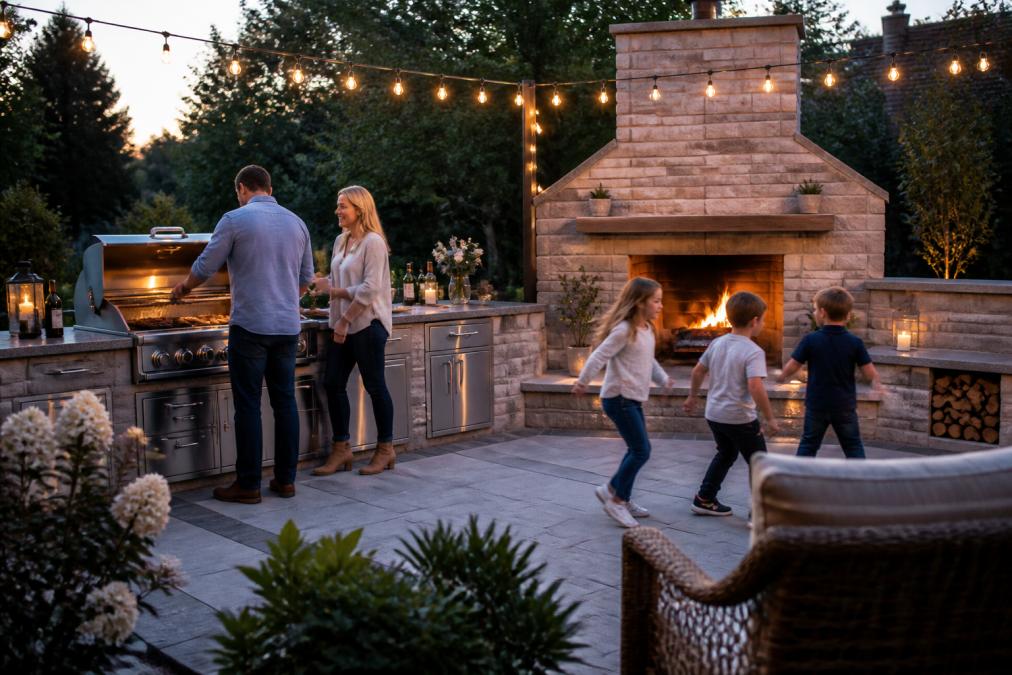
Practical priorities for a custom outdoor kitchen:
- Counter height and depth matched to how the family actually cooks
- A grill with a dedicated gas line rather than a portable tank
- Weather-rated countertop material that handles freeze-thaw and sun
- Storage that keeps tools out of the weather
Outdoor Lighting, Seating, and Social Hubs
Lighting turns a backyard from a daytime amenity into an evening destination. The goal is layered light, not maximum brightness.
Three layers do most of the work:
- Path and step lighting for safety on circulation routes
- Pool and water lighting for ambiance and visibility
- Accent uplighting on trees, walls, and architectural features for depth
Sustainable Materials and Smart Outdoor Technology
Two angles most guides skip, and both affect long-term cost. Sustainable materials change what a space costs to own; smart technology changes what it costs to run. Together they separate an outdoor living space that looks current at installation from one that still performs a decade later.
Sustainable and Eco-Friendly Materials
Sustainable materials have moved from niche to practical, driven by durability as much as environmental preference.
- Composite decking made from recycled content resists rot, splintering, and fading with less maintenance than traditional wood, which removes the recurring cost of staining and sealing. The trade-off is a higher upfront material cost and a surface that gets warmer underfoot in direct sun, so shade planning matters more.
- Permeable pavers manage stormwater on site by letting water infiltrate between units rather than running off. This matters in areas with impervious-cover limits, where a solid patio can push a lot over the site’s allowance and force a redesign. Permeable systems need periodic cleaning of the joint material to keep draining, so they carry a maintenance step that solid pavers do not.
- Native and drought-tolerant planting cuts irrigation demand without looking sparse. Once established, native beds typically need less supplemental water and fewer inputs than conventional turf, which lowers both water cost and upkeep labor.
- Reclaimed or regionally sourced hardscape reduces transport footprint and can give a patio or wall a material character that mass-produced units do not.
U.S. Environmental Protection Agency WaterSense program
Smart Outdoor Technology
Smart outdoor technology is the second lever, largely ignored in lifestyle coverage even though it directly reduces operating cost.
- Pool automation now handles pump scheduling, heater control, and lighting scenes from a phone. Running the pump on a schedule matched to actual use, rather than a fixed timer, reduces energy waste, and the same controller lets a homeowner or property manager adjust settings remotely.
- Automated irrigation with soil-moisture or weather-based control waters only when the landscape needs it, which is where most outdoor water savings come from. Zone-by-zone scheduling also protects plantings during the establishment period.
- Smart lighting controls put path, pool, and accent fixtures on scenes and schedules, so the space is lit when it is used and dark when it is not.
- Leak detection and freeze protection are the features worth prioritizing in a market that sees occasional hard freezes. A freeze-protection cycle that starts the pump before a cold snap can prevent cracked equipment and plumbing, which is a repair cost avoided rather than a convenience gained.
When specifying smart systems for a rental or multi-family property, prioritize remote monitoring and freeze/leak protection over app-based scene control. The first two prevent expensive failures; the third is a convenience.
Why These Two Belong Together
Sustainable materials and smart technology solve the same problem from opposite ends. Materials reduce maintenance and replacement needs; smart controls reduce energy and water consumption. For a property development project, specifying both keeps an enhanced outdoor living space low-cost to own, the same quality that makes it attractive to a buyer or renter.
Multi-Family Properties and Amenity Space Planning
For multi-family properties, outdoor amenity space is a leasing and valuation asset, not an afterthought. Shared seating, grilling stations, and shaded gathering areas extend a building’s usable footprint without adding interior square footage.
Spatial planning for these properties differs from single-family work in three ways:
- Durability and low maintenance outrank personalization
- Zones must accommodate groups of varying sizes
- Commercial-grade equipment and finishes hold up to constant use
Conclusion
The hard part of an outdoor living space project is not choosing features. It is coordinating hardscape, permitting, pool systems, and lighting so the finished yard functions as one space instead of five disconnected ones.
Frequently Asked Questions
What features add the most value to an outdoor living space?
Built-in outdoor kitchens, fire features, and well-designed hardscaping consistently rank among the top value drivers. A functional layout with patio design, pergolas, and outdoor lighting creates usable square footage that buyers count as living space. In property development, these features increase curb appeal and help justify higher asking prices, especially when integrated with a pool or entertainment area.
How does an enhanced outdoor living space impact property resale value?
An enhanced outdoor living space expands functional living square footage, which appraisers and buyers factor into resale value. Features like outdoor kitchens, fire pits, and covered seating extend year-round enjoyment and differentiate a home in competitive markets. While exact returns vary by region and market conditions, agents frequently cite outdoor living areas as a top feature that speeds up sales and supports property appreciation.
How can you design a backyard that is both kid-friendly and sophisticated?
Zoning is the key. Separate a pool area with safety fencing and non-slip decking from a grassy play zone, then anchor the design with refined materials like natural stone and architectural lighting. Family-friendly pool landscaping such as shade trees, low-maintenance plantings, and built-in seating keeps the space practical. A cohesive color palette and clean lines tie the zones together so the yard feels intentional rather than playground-like.
What are the best materials for durable outdoor living areas?
For hardscaping, natural stone, porcelain pavers, and concrete with a textured finish hold up well in heat and freeze-thaw cycles. Sustainable options like recycled composite decking and reclaimed wood reduce environmental impact while lasting decades. Pair these with powder-coated aluminum or teak furniture and weather-rated outdoor kitchen components. In property development, choosing materials rated for local climate conditions lowers maintenance costs and protects long-term ROI.

