
Table of Contents
- How Chlorine Pool Sanitation Alternatives Compare
- Saltwater Pool Pros and Cons
- Cost of Converting to Saltwater Pool
- Best Pool Sanitation System for Sensitive Skin
- UV and Ozone Systems: What They Do and Don’t Do
- Retrofitting vs. New Installation: What to Know
- Water Chemistry Troubleshooting for Alternative Systems
- Conclusion
- Frequently Asked Questions
Last Updated: September 16, 2026
How Chlorine Pool Sanitation Alternatives Compare
If you’re searching for alternatives to traditional chlorine pool sanitation, you’re not alone. Swim Clean Pool hears the same complaints from North Texas homeowners every season: red eyes, chemical smell, bleached swimsuits, and dry skin. Modern sanitation technology now offers several viable paths away from heavy chlorine use, and this guide breaks down how each one works.
Chlorine pool sanitation uses chlorine-based compounds to oxidize contaminants and provide a residual sanitizer that keeps water safe between treatments. Alternatives reduce or replace that load using salt cells, minerals, UV light, ozone, or hydroxyl radicals. Below, we compare the leading options so you can match one to your pool, budget, and skin.
| System | How It Works | Chlorine Reduction | Best For |
|---|---|---|---|
| Salt chlorine generator | Electrolysis converts salt to chlorine | Produces its own chlorine | Hands-off automation |
| Mineral ionizer | Releases copper and silver ions | Up to 80% less | Lower chemical handling |
| AOP / hydroxyl systems | Hydroxyl radicals oxidize contaminants | Up to 90% less | Lowest chlorine levels |
| Copper ionization | Copper kills algae and bacteria | Near-total removal | Chlorine-free routines |
| UV + ozone | Light and gas destroy pathogens | No residual on its own | Supplemental pathogen control |
The key distinction: some systems replace chlorine outright, while others only reduce how much you add. That difference drives everything from operating costs to water chemistry management.
Saltwater Pool Pros and Cons
Saltwater pools are the most popular chlorine alternative for good reason. Electrolysis converts dissolved salt into chlorine automatically, so you never handle tablets or shock by hand. The water feels softer, smells cleaner, and the residual sanitizer stays more consistent than manual dosing.
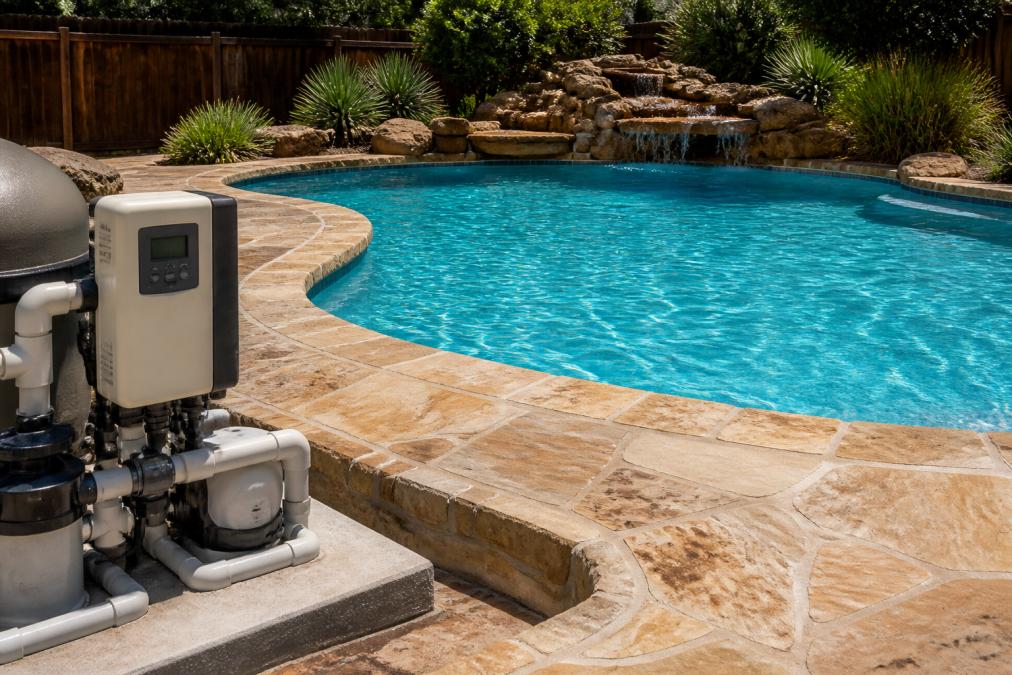
The drawbacks matter too. Salt is corrosive to certain equipment, decking, and natural stone, shortening system longevity if you don’t choose materials carefully. You’ll also need to monitor salt levels, clean the cell regularly, and accept that the generator still produces chlorine, just on site.
Pros:
- Consistent sanitizer levels prevent algae blooms
- Lower ongoing chemical costs per season
- Softer water feel with minimal chlorine odor
Cons:
- Salt corrosion risk to equipment and decking
- Cell replacement adds to long-term operating costs
- Still a chlorine-based system at its core
The Real Cost of Converting to Saltwater
Conversion cost depends on pool size, existing plumbing, and whether your equipment pad can support a generator. A salt cell typically runs a few hundred to a couple thousand dollars, but the full picture includes electrical work, plumbing compatibility checks, and sometimes new decking or coping. Because pricing varies so widely, get a site-specific quote rather than trust a national average.
Skipping a plumbing compatibility check before converting is the mistake that costs homeowners the most. Saltwater systems accelerate corrosion in certain metals and stone, and fixing that after installation means replacing equipment you just paid for.
Cost of Converting to Saltwater Pool
The cost of converting to a saltwater pool is a bundle: the generator and cell, electrical supply at the equipment pad, plumbing adjustments, and any material upgrades needed to handle salt exposure. Pools with older pumps, heaters, or natural stone coping usually cost more because those components may need replacement or protection.
Two cost categories drive the total:
- Upfront: generator, cell, installation labor, electrical work
- Ongoing: replacement cells, salt, occasional professional service
A common mistake is comparing only the generator’s sticker price against a season of chlorine tablets. That ignores cell replacement every few years and potential corrosion repairs. The fair comparison is total cost over five to seven years, not the first invoice.
A Five-Year Total Cost of Ownership Framework
Rather than guess at a national average, build the comparison yourself. The goal is to put saltwater and traditional chlorine on the same five-year footing so the decision is based on your pool, not a marketing claim.
Step 1, Upfront conversion cost. Add the generator unit, the salt cell, installation labor, any electrical work to supply the equipment pad, and any plumbing or material upgrades. This is a one-time number.
Step 2, Annual consumables. For saltwater: salt and cell cleaning supplies. For traditional chlorine: tablets, shock, and stabilizer. Track these for one full season to get a real baseline.
Step 3, Replacement cycle. Salt cells have a finite life, typically replaced every few years depending on run time and water chemistry.
Ask your installer to quote the conversion in two parts: equipment and labor now, plus projected cell replacement and service costs over the next five years. Seeing both numbers side by side is the only way to judge whether saltwater actually saves you money in your specific pool.
A five-year framework is only as good as its inputs. If you skip the corrosion contingency line because your pool has natural stone coping or older metal fixtures, the comparison will look better than reality. Budget for the risk even if you never use it.
What Actually Moves the Payback Period
Three variables dominate whether saltwater pays off:
- Cell life. A cell that lasts longer lowers the annualized replacement cost and shortens payback.
- Electricity cost. The generator draws power whenever it runs, so local utility rates matter.
- Chemical prices. When chlorine tablet and shock prices rise, the saltwater case improves.
Run the framework with your own numbers rather than relying on a rule of thumb. The answer is genuinely pool-specific.
Best Pool Sanitation System for Sensitive Skin
The best pool sanitation system for sensitive skin minimizes disinfection byproducts and keeps sanitizer levels low but stable. Irritation usually traces back to chloramines, compounds formed when chlorine reacts with sweat, sunscreen, and body oils, not chlorine itself. Systems that oxidize those contaminants aggressively let you run lower residual sanitizer levels.
Sensitive skin responds to disinfection byproducts, not to the presence of chlorine alone. Reducing chloramine formation through better oxidation often solves the irritation problem without abandoning chlorine completely.
UV and Ozone Systems: What They Do and Don’t Do
UV and ozone systems are supplements, not replacements. Both destroy pathogens and oxidize organic waste, but neither leaves a residual sanitizer, so they cannot protect your pool between treatment cycles on their own.
Retrofitting vs. New Installation: What to Know
Retrofitting an existing pool is usually straightforward for salt cells, mineral ionizers, and UV or ozone units, since most install inline with existing plumbing. The deciding factors are equipment pad space, electrical capacity, and plumbing compatibility.
A quick decision framework:
- Retrofit if your equipment pad has space, adequate electrical service, and plumbing that accepts an inline unit
- New installation if you’re already renovating, replacing major equipment, or building from scratch
- Either way, verify material compatibility before committing to a salt-based system
Water Chemistry Troubleshooting for Alternative Systems
Every alternative system changes how you manage water chemistry, and that’s where most owners get tripped up. Saltwater pools need consistent salt levels and periodic cell cleaning. Mineral and copper systems require ion monitoring to prevent staining. UV and ozone systems need lamps and generators serviced on schedule.
The core parameters don’t change:
- pH balance and alkalinity still need regular testing
- Total dissolved solids rise over time and affect sanitizer efficiency
- Filtration efficiency determines how well any system performs
- Shock treatment remains useful for clearing contaminants after heavy use
How Non-Chlorine Systems Behave Differently
When you step away from a chlorine residual, the water stops behaving the way you learned to expect, and standard advice stops working.
A Simple Troubleshooting Order
When water goes cloudy, green, or irritating after a switch, work through this order before blaming the equipment:
- Test pH and alkalinity first. Most clarity problems trace back to unstable pH.
- Check stabilizer level. High cyanuric acid suppresses whatever residual you have.
- Check ion or salt levels if you run a mineral or salt system.
- Check filtration. A clogged or undersized filter will defeat any sanitation method.
- Check oxidation. If bather load was high, you may simply need to oxidize.
Conclusion
Choosing among alternatives to traditional chlorine pool sanitation comes down to your priorities: lowest chlorine levels, best feel for sensitive skin, or simplest maintenance. Each system trades one set of hassles for another, and the right pick depends on your pool’s construction and how you use it.
Frequently Asked Questions
What are some healthy alternatives to chlorine for swimming pool sanitation?
Salt chlorine generators, mineral ionizers, UV systems, ozone generators, and AOP systems all reduce reliance on traditional chlorine. Salt systems use electrolysis to create chlorine on site, while mineral ionizers release copper and silver ions to inhibit algae and bacteria. UV and ozone systems break down contaminants but need a residual sanitizer. AOP systems use hydroxyl-based oxidation to cut chlorine demand by up to 90%.
Is a saltwater pool considered chlorine-free?
No. Saltwater pools still use chlorine as the primary sanitizer. The salt cell converts dissolved salt into chlorine through electrolysis. The difference is that chlorine is produced continuously rather than added manually. Many owners find the water feels softer and causes less skin irritation, but it is not a chlorine-free pool sanitation method.
What is the best pool sanitation system for sensitive skin?
Systems that lower chlorine levels or reduce disinfection byproducts help most. AOP and mineral ionizers reduce chlorine demand by up to 80-90%, which can ease skin irritation and allergic reactions. Saltwater pools also feel gentler for some users. Always maintain a small residual sanitizer for pathogen control and check pH balance, since pH swings cause more irritation than chlorine itself.
How do mineral systems compare to traditional chlorine tablets?
Mineral ionizers use copper and silver zinc cartridges to reduce chlorine requirements by up to 80%. They eliminate the chlorine smell and improve water clarity. Unlike tablets, they do not add cyanuric acid or raise total dissolved solids as quickly. However, they still need a low chlorine residual for complete sanitation and require monitoring copper levels to prevent staining.
What are the maintenance requirements for UV and ozone pool systems?
UV and ozone systems require periodic lamp or cell replacement, typically every 1-2 years, and annual professional service. They do not provide a residual sanitizer, so you must maintain a low chlorine level (often 0.5-1.0 ppm) to protect against pathogens in the pool vessel. Cartridge filters should be cleaned regularly to maintain filtration efficiency and system longevity.

