
Table of Contents
- Why Cloudy Water Happens in Custom Pools
- Test and Balance Your Pool Water Chemistry Balance
- Apply Pool Shock Treatment to Kill Organic Contaminants
- Follow a Consistent Pool Filter Maintenance Schedule
- How to Use Pool Clarifier to Remove Sediment and Turbidity
- Clear Debris and Maintain Water Circulation Daily
- Manage Weather Impact and Post-Storm Recovery
- When to Call a Professional Pool Service
- Frequently Asked Questions
Last Updated: September 28, 2026
Cloudy pool water ruins the whole experience, but preventing cloudy water is achievable with the right approach. The problem isn’t random, it happens because something in your water chemistry or filtration system has gone wrong.
This guide walks you through the exact steps to restore crystal-clear water, whether you’re dealing with a chemistry imbalance, filter issues, or debris buildup.
Why Cloudy Water Happens in Custom Pools
Cloudy water stems from suspended particles too small for your filter to catch, water chemistry imbalance, or organic contaminants like algae spores. Fine sediment and dead algae cells slip through unless your water chemistry keeps them under control.
Custom pools have unique equipment, water volume, and circulation patterns. What works for a neighbor’s pool might not work for yours.
The good news: preventing cloudy water follows a simple formula. Test your chemistry regularly, maintain your filter properly, and keep debris out. Most cloudy water problems clear up within 24 to 48 hours once you identify the cause.
Test and Balance Your Pool Water Chemistry Balance
Water chemistry is the foundation of clarity. When pH, alkalinity, and chlorine levels are off, particles suspend instead of settling or being filtered.
Check pH and Total Alkalinity First
pH measures acidity or alkalinity; ideal range is 7.2 to 7.6. Total alkalinity keeps pH stable and should sit between 80 and 120 ppm (parts per million).
Test pH using a water testing kit. High pH (above 7.6) causes cloudiness and reduces chlorine effectiveness. Low pH (below 7.2) corrodes equipment and causes murky water.
Total alkalinity acts as a buffer. Low alkalinity causes pH swings; high alkalinity makes pH hard to adjust. Both harm water clarity.
Adjust alkalinity before pH, as it affects the final pH reading. Use pH increaser or decreaser, and alkalinity increaser as needed.
Measure Free Chlorine and Calcium Hardness
Free chlorine kills organic contaminants and keeps water sanitized. Target 1 to 3 ppm; below 1 ppm algae grows, above 3 ppm water tastes bad without improving clarity.
Calcium hardness measures dissolved minerals; target 200 to 400 ppm. Hard water (above 400 ppm) causes cloudiness and scale; soft water (below 200 ppm) corrodes equipment.
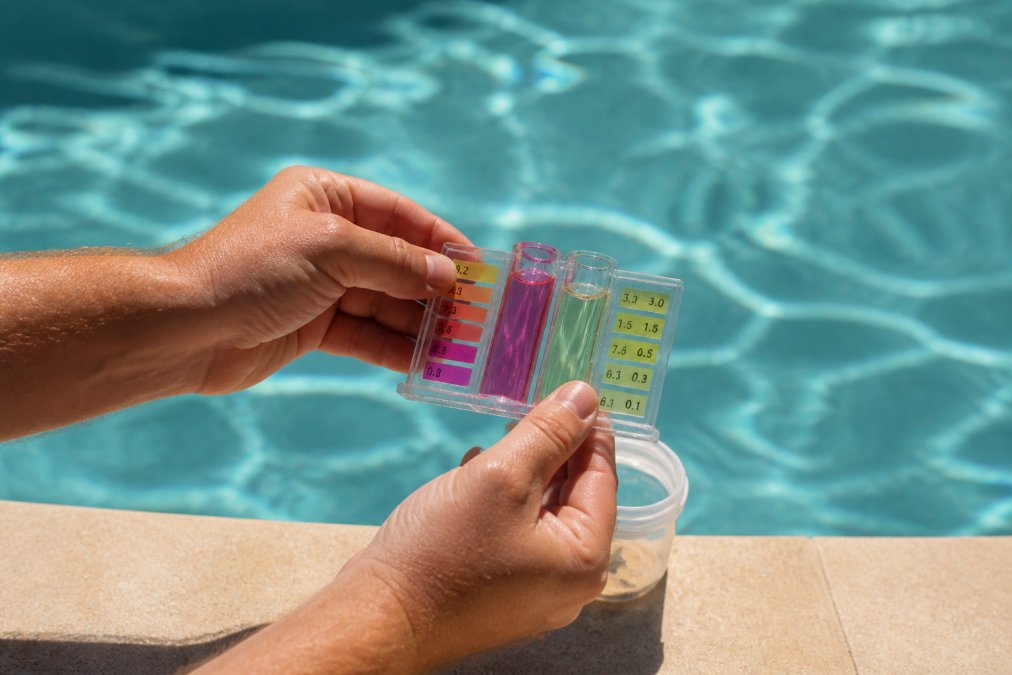
Test all four levels weekly during swimming season. A basic water testing kit costs under $20 and catches problems early.
Apply Pool Shock Treatment to Kill Organic Contaminants
Pool shock is a concentrated dose of chlorine that kills algae spores, bacteria, and organic matter. Shock floods your pool with sanitizer to break down contaminants that regular chlorine can’t handle alone, with results within hours.
Apply shock at dusk or after sunset, as sunlight breaks down chlorine. Follow the product label dosage for your pool size.
After shocking, wait 8 to 12 hours before swimming. Run your pump and filter continuously during this time. The moving water helps distribute the shock and allows your filter to catch the dead contaminants.
Follow a Consistent Pool Filter Maintenance Schedule
Different filter types require different maintenance protocols. A dirty or clogged filter can’t do its job, and cloudiness often signals that your filter needs attention.
Sand Filters: Backwashing Frequency and Media Replacement
Sand filters trap particles in sand media. Over time, sand becomes compacted and coated with debris, reducing flow and trapping effectiveness.
When to backwash: Backwash when pressure reads 8 to 10 psi above your filter’s clean baseline. For most residential pools, this occurs every 2 to 4 weeks during heavy use.
How to backwash properly:
- Turn off the pump completely.
- Switch the multiport valve to “Backwash.”
- Turn the pump back on and run until water in the sight glass runs clear (usually 3-5 minutes).
- Turn off the pump, switch the valve to “Rinse,” and run for 30 seconds to settle the sand.
- Turn off the pump, return the valve to “Filter,” and resume normal operation.
Sand media replacement: Replace sand every 3 to 5 years. If cloudiness persists despite backwashing and shock treatment, the sand may be exhausted and unable to trap fine particles.
DE (Diatomaceous Earth) Filters: Powder Coating and Grid Integrity
DE filters use a powder coating on grids to trap particles smaller than sand can catch, requiring more active maintenance.
Backwashing and powder reapplication: Backwash DE filters the same way as sand filters, when pressure rises 8 to 10 psi above baseline. However, backwashing removes the DE powder coating entirely. After every backwash cycle, you must add fresh DE powder to restore filtration effectiveness.
How much DE to add: Check your filter’s manual for the exact amount (typically 2-4 pounds for residential pools). Add powder through the skimmer with the pump running.
Cartridge Filters: Pleated Media Cleaning and Replacement Cycles
Cartridge filters don’t backwash; you remove and rinse the pleated element instead. This design requires hands-on maintenance.
Identifying Filter Failure as the Root Cause
If water stays cloudy after shock treatment, clarifier, and proper chemistry balance, your filter may be failing. Check pressure gauge readings, observe return jet flow, and run the filter 24 hours with no new additions. If water doesn’t clear, the filter isn’t trapping particles. Consult your filter’s manual or contact a professional.
How to Use Pool Clarifier to Remove Sediment and Turbidity
Clarifier differs from shock treatment: shock kills organic contaminants; clarifier clumps suspended particles so your filter can catch them.
How Clarifier Works: Particle Aggregation
Clarifier contains polymers that bind fine particles into larger clumps heavy enough for your filter to trap. The process takes time, clarifier doesn’t work instantly like shock.
Clarifier vs. Flocculant: Mechanism and Trade-offs
Clarifier:
- Works slowly (12-24 hours) but continuously as water circulates.
- Clumps remain suspended; your filter catches them over time.
- Requires no manual vacuuming, the filter does the work.
- Best for sand and DE filters, which handle fine particles well.
- Leaves no residue; water stays balanced.
Flocculant:
- Works quickly (2-4 hours); particles clump and sink to the pool floor.
- Requires you to manually vacuum the settled debris from the bottom.
- More aggressive; removes particles faster than clarifier.
- Works well with cartridge filters, which may struggle with the fine particles clarifier produces.
- Leaves settled debris that must be removed, if not vacuumed, it re-suspends and clouds water again.
Decision framework: Use clarifier with sand or DE filters if you can wait 24 hours. Use flocculant with cartridge filters if you need results in hours and will vacuum afterward. For severe cloudiness, shock first, then clarifier or flocculant.
Water Chemistry Interactions: Why pH and Chlorine Matter
Clarifier effectiveness depends on water chemistry. High pH, high chlorine, or imbalanced alkalinity can reduce performance.
Step-by-Step Clarifier Application
- Test water chemistry: Adjust pH to 7.2-7.6 and alkalinity to 80-120 ppm.
- Wait after shock: If you’ve shocked in the last 12 hours, wait until free chlorine drops below 3 ppm.
- Calculate dosage: Most clarifiers dose at 1-2 quarts per 10,000 gallons.
- Add clarifier: Pour into the skimmer with the pump running.
- Run filtration continuously: Keep pump and filter running 24 hours without backwashing.
- Monitor clarity: Water should clear within 12 to 24 hours. If not, the issue may be algae or a filter problem.
When Clarifier Doesn’t Work
If water stays cloudy after 24 hours of clarifier treatment, the problem is likely not sediment. Check for algae bloom (shock first), filter failure (backwash or replace media), circulation problems (check return jets and pump), or chemistry imbalance (retest and rebalance). If cloudiness persists, shift focus to shock treatment, filter maintenance, or professional diagnosis.
Clear Debris and Maintain Water Circulation Daily
Skim the surface every morning and empty the skimmer basket when half full. Check the pump strainer basket weekly. Run your pump at least 8 to 12 hours daily during swimming season to prevent dead spots where particles settle and algae grows. Check that water flows smoothly through return jets; blocked returns cause poor circulation and cloudiness.
Manage Weather Impact and Post-Storm Recovery
After heavy rain, test water chemistry immediately and rebalance pH and alkalinity before shock treatment. Skim debris, run your filter continuously for 24 hours, and shock if rain was heavy or water looks cloudy. Most pools clear within 24 to 48 hours if you act quickly.
When to Call a Professional Pool Service
Some problems need professional help. If water stays cloudy after shock and clarifier, your filter might be failing. If chemistry won’t balance despite multiple attempts, your water may have underlying issues. Swim Clean Pools LLC specializes in equipment replacement and maintenance for custom pools across North Dallas, Texas, and surrounding areas.
Call a professional if:
- Cloudiness persists after 48 hours of shock and filtration
- Your filter pressure won’t drop after backwashing
- Water chemistry won’t hold stable
- You notice equipment leaks or unusual noises
Frequently Asked Questions
What is the most common cause of cloudy water in pools?
Improper pool water chemistry balance is the leading cause. When pH, alkalinity, or free chlorine levels drift out of range, water clarity suffers immediately. Poor filtration and inadequate water circulation also trap suspended particles that create cloudiness. Testing your water twice weekly and maintaining consistent circulation prevents most cloudiness before it starts.
How long does it take for cloudy pool water to clear?
With proper treatment, most cloudy water clears within 24-48 hours. If you apply pool shock and run your filter continuously, clarity improves faster. However, if the underlying cause (chemical imbalance, filter clogging, or poor circulation) isn’t fixed, cloudiness returns. Persistent cloudiness lasting over 48 hours signals a deeper issue requiring professional diagnosis.
Can too much chlorine make a pool cloudy?
Yes. Excessive free chlorine can create cloudiness, especially when combined with high cyanuric acid levels or calcium hardness. This is called chlorine lock. High chlorine also reacts with organic contaminants to form chloramines, which cloud water and smell strong. Keep free chlorine between 2-4 ppm for residential pools and maintain cyanuric acid at 30-50 ppm to prevent over-chlorination.
How does pool filtration impact water clarity?
Filtration removes sediment, algae spores, and organic debris that cause turbidity. Sand filters, DE filters, and cartridge filters each trap particles differently; DE filters catch the finest sediment. A clogged filter can’t work effectively, so backwashing sand/DE filters weekly and cleaning cartridge filters every 2-3 months keeps water clear. Running your pump 8-12 hours daily ensures adequate filtration cycles.

