
Table of Contents
- What Defines a Luxury Pool Design in 2026?
- Luxury Pool Water Features That Make a Statement
- Custom Pool Landscaping Ideas for a Resort-Style Backyard
- Smart Pool Automation Systems for Effortless Control
- High-End Materials and Finishes for Luxury Pools
- Planning Your Luxury Pool Design: Timeline, Costs, and Compliance
- Frequently Asked Questions
Last Updated: September 14, 2026
What Defines a Luxury Pool Design in 2026?
Luxury pool design is the practice of creating a custom swimming environment where architecture, materials, water behavior, and outdoor living space are planned as a single composition rather than assembled from a catalog. In 2026, that definition has shifted toward restraint: quieter geometry, fewer visible seams, and technology that disappears into the structure.
The strongest luxury pools share four traits:
- Custom geometry drawn from the property’s actual sightlines, not a template
- Elevation changes that let water move, spill, or vanish at an edge
- Materials chosen for how they age, not just how they photograph
- Integrated surroundings where pool deck, hardscaping, and planting read as one design
The clearest test of a luxury pool is what you cannot see: hidden equipment, flush coping, concealed lighting, and a waterline that meets tile without a visible gap.
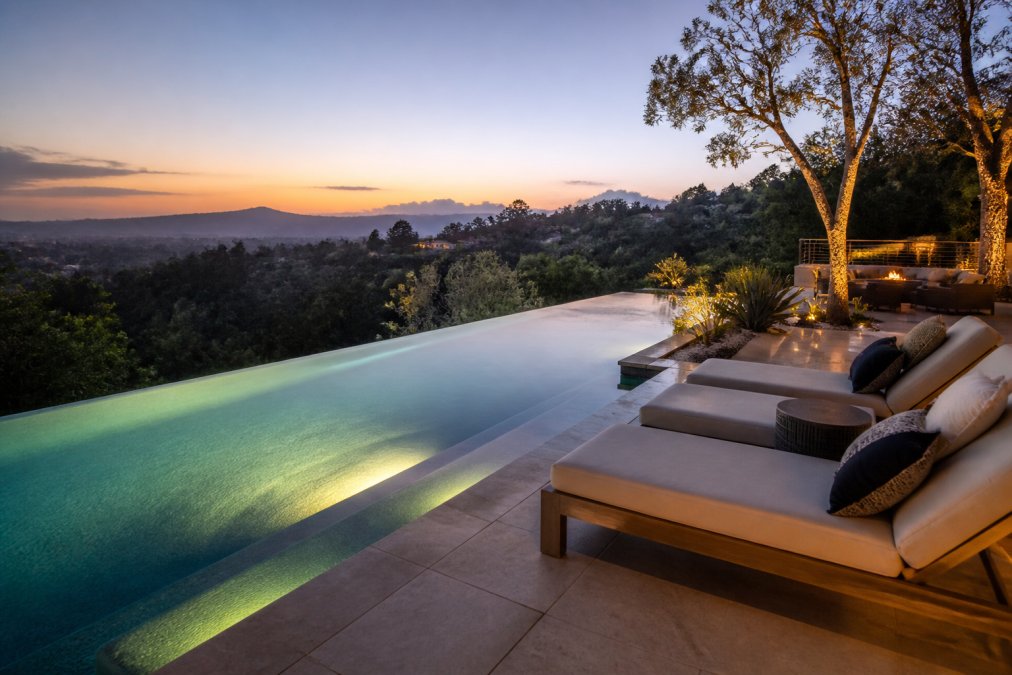
Minimalist pools have overtaken the ornate look in high-end residential work. Clean rectangular basins, zero-entry transitions, and a single material palette now signal more status than elaborate rock formations, and fewer materials means fewer failure points.
Luxury Pool Water Features That Make a Statement
The most effective luxury pool water features are the ones you hear before you see. A well-tuned infinity edge, sheer descent wall, or laminar jet produces a specific sound and shadow, and both belong in the design brief.
Here is how the main options compare:
| Feature | Visual Effect | Maintenance Load | Best Placement |
|---|---|---|---|
| Infinity edge | Water merges with horizon | Moderate, needs level catch basin | View-facing side only |
| Sheer descent | Smooth glass-like sheet | Low | Raised wall or spa spillover |
| Laminar jet | Arcing glass rod of water | Low, but sensitive to pressure | Open deck, lit at night |
| Integrated spa | Spillover into main pool | Moderate | Adjacent to seating |
| Fire bowls with water | Contrast of flame and reflection | Low | Symmetrical flanking pairs |
A common mistake is stacking three or four features onto one pool. Each needs its own pump curve and visual breathing room; two executed well outperform five competing for attention.
Infinity edges require a catch basin and precise elevation survey. On a flat lot without a view, the effect is wasted, and the catch basin adds ongoing water loss through evaporation. Confirm the sightline before committing.
Custom Pool Landscaping Ideas for a Resort-Style Backyard
Resort-style results come from landscape architecture, not pool accessories. The pool is the anchor, but the deck, hardscaping, and planting determine whether the space feels like a hotel courtyard or a suburban rectangle.
Start with these moves:
- Run the deck material into the coping. A single stone or paver that continues from pool edge to patio eliminates the visual border and makes the water read as larger.
- Build a planted screen on the property line. Layered trees and shrubs create the privacy that resort properties get from distance.
- Add a fire pit at the opposite end from the pool. It pulls circulation through the space and gives the yard a second destination after dark.
- Use level changes instead of walls. A single step down to a sunken lounge does more for the composition than a decorative retaining wall.
- Repeat one plant species in mass. Scattered variety looks like a nursery. Repetition looks designed.
For custom pool landscaping ideas, the constraint is usually the lot itself: an existing oak, an odd setback, or a narrow side yard. Those constraints are where custom design earns its fee. A pool shaped around a mature tree, with the trunk left in a planted island, will always look more intentional than a rectangle that ignored it.
Smart Pool Automation Systems for Effortless Control
Smart pool automation systems consolidate circulation, filtration, heating, chemistry, and lighting into one control layer accessible from a phone or wall panel. They matter most in climates with wide seasonal swings, where the equipment schedule changes several times a year, and in luxury builds, where technology should disappear into the structure rather than announce itself with a pad full of timers and toggle switches.
What a Modern System Actually Controls
- Pump speed and daily circulation windows (variable-speed or variable-flow)
- Filter cycles, pressure monitoring, and backwash reminders
- Heater and heat pump setpoints, plus freeze-protection overrides
- Sanitizer output and pH/ORP monitoring with dosing control
- LED color scenes, schedules, and zone-by-zone dimming
- Spa, water feature, and laminar jet activation
- Valve actuators for shared suction/return between pool and spa
How the Components Talk to Each Other
A residential automation system is a small control network. The head-end controller (a wall panel or phone app) sends commands over a low-voltage bus to relay boxes, valve actuators, and sensor modules. Most manufacturers use a proprietary bus and expose limited third-party integrations, commonly RS-485 serial, dry-contact relays, or a manufacturer-specific API, so “works with” claims must be verified at the model level, not the brand level.
A common pattern is a hybrid: the automation controller runs the schedule and scenes, while a separate chemistry controller reads pH and ORP and drives dosing pumps, reporting back over a serial link. When those two systems come from different manufacturers, the integration is where most field problems show up.
The Energy Math Behind Variable-Speed Pumps
A pump’s power draw rises roughly with the cube of its speed. Halving the RPM cuts energy to roughly one-eighth while still moving a meaningful fraction of the water, because flow scales more gently than speed. That is the case for running a variable-speed pump at low RPM for long windows instead of a single-speed pump in short bursts, and automation is what makes that schedule realistic.
Ask for the pump’s energy-factor and the manufacturer’s flow-vs-RPM curve before you approve the equipment package. The curve tells you the turnover you can actually achieve at the noise level you want, and it is the single best predictor of operating cost.
Compatibility Traps to Resolve Before You Buy
- Older single-speed pumps often cannot be speed-controlled, only switched on and off. Replacing the pump is usually cheaper than automating around it.
- Mechanical timers and basic freeze guards expose no data interface; they must be removed, not integrated.
- Salt chlorine generators from one brand may not report salinity to another brand’s controller, costing you the low-salinity warning that protects the cell.
- Heat pumps vary in whether they accept a remote setpoint or only a dry-contact on/off call, which limits scheduling precision.
- Lighting is the most fragmented category: color scenes only work as designed when every fixture is on the same protocol and generation.
What to Specify in the Design Phase
Plan the equipment package and control system together, not sequentially. Design documents should name the controller model, list every device on the bus, and state each integration method. Leave spare relay capacity and a spare conduit run to the pad, luxury builds almost always add a feature later, and a spare conduit during excavation is trivial compared to trenching a finished deck.
U.S. Department of Energy guidance on pool pump energy use explains how pump selection and run schedules affect operating cost, and is worth reading before you approve a variable-speed upgrade.
High-End Materials and Finishes for Luxury Pools
Material selection is where most budgets quietly move. Finishes above the waterline and surfaces below it are separate decisions with separate price drivers.
Waterline tile sets the character of the pool. Glass tile produces depth and color shift but demands a very flat substrate and more installation labor; natural stone reads more muted and organic.
Coping is the edge you touch and walk on. Travertine stays cool underfoot, natural stone offers the widest color range, and poured concrete gives the cleanest modern line.
Interior finish determines the water’s color. White or light blue plaster produces a bright, classic look; darker finishes absorb light and create a reflective, almost black surface that shows debris and imperfections far more readily.
Decking ties the composition together. In full sun, light-colored concrete, pavers, or stone stays walkable where darker material does not.
Ask to see a sample of the interior finish submerged in water, not dry on a board. Plaster and aggregate shift color dramatically once wet, and a dry sample will mislead you every time.
Planning Your Luxury Pool Design: Timeline, Costs, and Compliance
Most luxury pool guides stop at the renderings. The two things that actually derail a build, permitting and long-term ownership cost, are the two things inspiration galleries never cover.
Zoning and Regulatory Compliance
Pool placement is governed locally, and the rules that bite hardest are rarely the ones homeowners expect. Confirm these categories before design begins:
- Setbacks from property lines, easements, and utility corridors. These are measured to the water’s edge in some jurisdictions and to the shell in others, the difference can move a pool several feet.
- Impervious cover limits, which count the pool, deck, and any hardscaping toward a lot-wide cap. On a small lot, a large deck can consume the allowance before the pool is even sized.
- Barrier and safety requirements, which typically specify fence height, gate self-closing and self-latching hardware, and sometimes an approved safety cover or alarm as an alternative. U.S. Consumer Product Safety Commission pool and spa safety guidance outlines the barrier and safety expectations that apply to residential pools.
- Electrical clearances, which govern how close the pool shell can sit to service drops, panels, and pool equipment bonding. These are set in the electrical code and enforced at inspection.
- Drainage and stormwater, which on sloped lots can require a retention plan or a dry well before a permit is issued.
On lots with expansive clay soil, structural engineering for the shell and deck is not optional, the soil moves seasonally, and an unreinforced shell will crack. Confirm the rules for your specific lot before design begins, because a setback or impervious-cover conflict can force a full redesign after engineering is already paid for.
Timeline: Where the Schedule Actually Slips
A custom build moves through design and engineering, permitting, excavation and shell, utilities and equipment, finishes, and finally decking and landscaping. The stages that slip most often are not the ones homeowners watch.
- Design and engineering is iterative and depends on how quickly decisions get made; every material change after this stage carries a cost.
- Permit review is the least predictable stage, timelines vary widely by jurisdiction and submittal complexity, and one correction notice can add weeks.
- Excavation and shell is the most weather-sensitive; access constraints like a narrow side yard or mature tree can turn a one-day dig into a multi-day operation.
- Utilities and equipment depends on lead times, which for specialty items like heat pumps and automation controllers can run past shell completion.
- Finishes and decking is where the visual payoff happens, and where the schedule is most exposed to curing and drying time.
Ask for a schedule that names each phase, states who owns it, and identifies the decision deadlines that keep it on track.
Cost Transparency
Pricing depends on size, access, soil conditions, materials, and equipment, so any figure quoted before a site review is a guess. A scope-based proposal itemizes allowances, tile, coping, interior finish, decking, equipment, so you can see where money goes and where a substitution changes the total. Ask how the proposal handles rock excavation, dewatering, and soil stabilization, the line items most likely to move after the dig starts.
Maintenance and Long-Term Ownership
This is the number most luxury buyers underestimate. Budget ongoing for:
- Chemistry: sanitizer, pH adjusters, and stabilizer, consumed faster in hot, sunny, heavily used pools.
- Filter media: cartridge replacement or backwash water and media top-off, on a cycle set by bather load and debris.
- Pump and heater service: seals, bearings, and heat exchanger cleaning, with replacement on a multi-year horizon.
- Resurfacing: interior finishes have a service life, and darker finishes and glass tile show wear sooner than light plaster.
- Feature upkeep: every water feature adds a pump, a valve, and a failure point. Infinity edges lose water to catch-basin evaporation; laminar jets are pressure-sensitive; fire bowls need fuel and ignition service.
- Landscaping: planting near a pool needs pruning, and tree debris drives chemistry and filter costs up.
A pool with more water features, more tile, and more planting costs more to keep, not just to build. The design decisions that raise the build cost usually raise the ownership cost in the same direction.
Climate-Specific Design
In hot, humid summers with occasional freezes, equipment pads need drainage and freeze protection, and finishes should be chosen for thermal stability as well as appearance. Shade structures and orientation matter as much as the pool itself, a west-facing deck in full afternoon sun is unusable in midsummer regardless of how good the water looks. In arid climates, evaporation and make-up water dominate the operating picture, and a cover or an automatic water-level controller earns its cost quickly. U.S. Environmental Protection Agency WaterSense pool and spa resources covers water efficiency practices worth building into the plan from the start.
Permit requirements, setback rules, and impervious-cover limits are set locally and change over time. Confirm the current rules for your specific lot with the authority having jurisdiction before design begins, a conflict discovered after engineering is paid for is the most expensive kind.
Swim Clean Pool provides a scope-based proposal rather than an estimate, with allowances itemized so you can see where money is going, and personally project manages each build from consultation through completion so you are not coordinating separate contractors when something needs a decision. For homeowners with an existing pool, the same team handles remodels and equipment replacement, and customer feedback reflects that: Kathy K. noted that the technician was professional, knowledgeable on all types of pool equipment, and got it done right the first time.
Frequently Asked Questions
What does a $100,000 pool look like?
A $100,000 pool typically includes a custom shape, high-end finishes like glass tile or natural stone, integrated spa, and advanced features such as a negative edge or fire bowls. Landscaping and automation may also be part of the package. Exact specifications depend on site conditions and material choices. For a personalized estimate, consult a design-build professional.
What are the current pool design trends?
Current trends include minimalist geometric shapes, negative-edge and infinity pools, integrated fire and water features, and smart automation for lighting and heating. Natural materials like stone and glass tile remain popular. Many homeowners also seek resort-style landscaping with lush plantings and cozy seating areas. These elements combine to create a cohesive outdoor living space.
How do custom water features impact luxury pool design?
Custom water features such as waterfalls, fountains, and scuppers add visual drama and soothing sound, transforming a pool into a sensory experience. They can also improve water circulation and aeration. Placement and scale are key to maintaining harmony with the overall design. A professional designer can integrate features that match your aesthetic and functional goals.
How does landscaping integrate with luxury pool design?
Landscaping softens hardscapes, provides privacy, and extends the outdoor living area. Tropical plantings, natural stone pathways, and strategic lighting create a resort-like atmosphere. The design should consider maintenance, climate suitability, and sightlines from the home. Collaborating with a landscape architect ensures the pool and garden feel like one cohesive space.
What is the typical timeline for a custom luxury pool project?
Timelines vary based on complexity, permits, and weather. A typical custom pool may take 3 to 6 months from design to completion. Projects with extensive features or outdoor structures can take longer. Early planning and clear communication with your builder help keep the project on track. Always confirm a detailed schedule before construction begins.

